
What is Web Design? A Complete Beginner’s Guide for Businesses
You know your Irish business needs a powerful online presence, but the moment you start exploring, you’re hit with a wave of jargon. UI, UX, front-end, back-end… it’s enough to make anyone’s head spin. You’re left wondering: what actually is web design, and how do you separate a website that just looks pretty from one that drives real, tangible business results? For over two decades, we’ve seen this confusion prevent great businesses from building a digital platform that truly performs and helps them stand out.
This guide is your clear, no-nonsense roadmap. We are pulling back the curtain to demystify the entire process, from the core principles that make a design effective to the practical steps of bringing a site to life. By the end, you’ll not only understand what makes a website successful, but you’ll also have the confidence to discuss your project with a professional and decide on the best path forward for a site that simply refuses to blend in.
What is Web Design? More Than Just Making Things Look Pretty
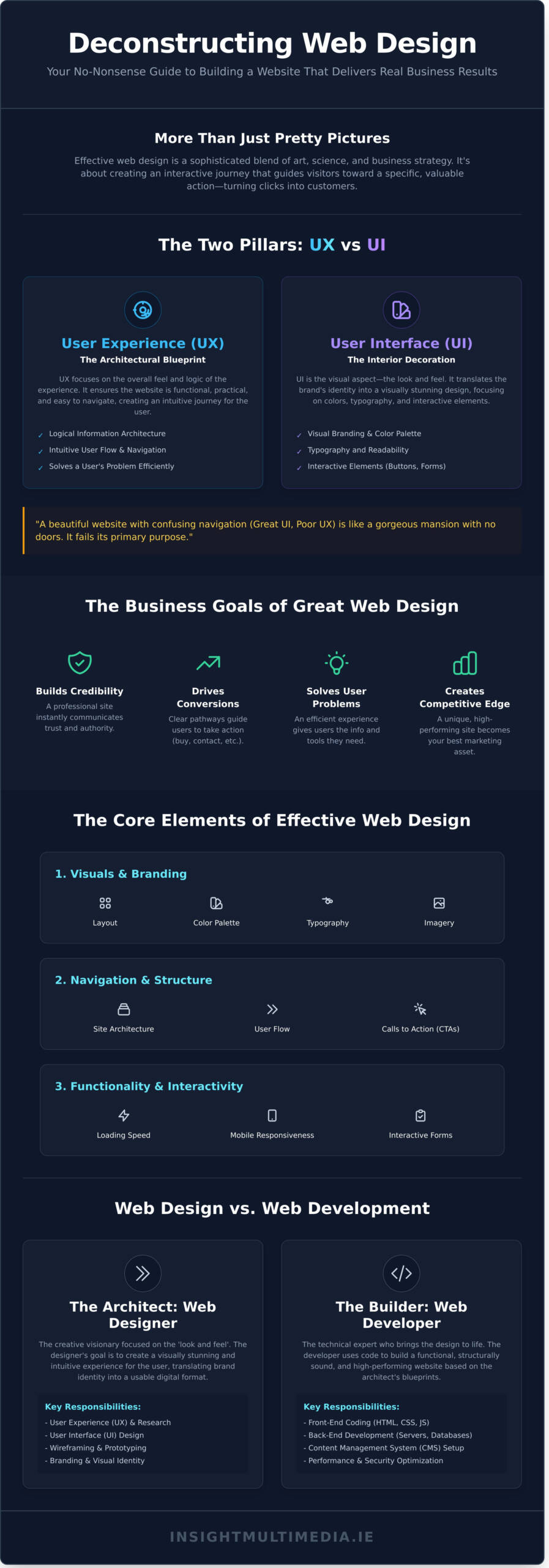
Many people think of web design as simply choosing colours and fonts. But in reality, it’s a sophisticated discipline that blends art with science and business strategy. At its core, professional Web design is the process of planning and building a user’s entire digital experience. Unlike a static print brochure, a website is an interactive environment. It’s not just about presenting information; it’s about creating a journey that guides visitors towards a specific, valuable action for your business-turning clicks into real business conversions.
The Two Pillars: User Interface (UI) and User Experience (UX)
To understand modern web design, you must grasp two critical components: UI and UX. Think of it like building a house. User Experience (UX) Design is the architectural blueprint-it ensures the layout is logical, the rooms flow intuitively, and the house is practical to live in. User Interface (UI) Design is the interior decoration-the paint colours, the stylish fixtures, and the furniture that make the house visually stunning. A beautiful website with confusing navigation (great UI, poor UX) is like a gorgeous mansion with no doors. It fails its primary purpose because users can’t find what they need.
The Business Goal of Great Web Design
At Insight Multimedia, we build websites for brands that refuse to blend in, and that means focusing on results. Exceptional design is a powerful business tool that goes far beyond aesthetics. It’s about strategically solving problems for both your customers and your company.
- Builds Credibility: A professional, polished website instantly communicates trust and authority in the Irish market.
- Drives Conversions: We design clear pathways that guide users to take action, whether that’s making a purchase, filling out a contact form, or requesting a quote.
- Solves User Problems: By understanding your audience, we create an experience that gives them the information and tools they need, efficiently.
- Creates a Competitive Edge: A unique and high-performing website becomes your most valuable marketing asset, setting you apart from the competition.
The Core Elements of Effective Web Design
A truly effective website is far more than a digital brochure; it’s a powerful business tool built on a foundation of strategic design principles. It’s where stunning visuals meet seamless usability to create an experience that not only captivates your audience but also drives tangible results. A successful web design marries creative flair with commercial purpose, ensuring every element works in harmony to guide users from their first click to a final conversion.
At the heart of this process are the core building blocks that define a site’s look, feel, and performance. We balance these components to build a platform that represents your brand perfectly and functions flawlessly for your customers.
Visuals and Branding
First impressions are everything. Your website’s visual identity is the immediate handshake with your visitors. This includes a strategic layout and composition that guides the user’s eye through the content, a carefully selected colour palette that evokes emotion and reinforces your brand, and elegant typography that ensures clarity while setting the right tone. We complete this picture with high-quality imagery-stunning photos, videos, and icons that communicate your message faster and more effectively than words alone.
Navigation and Structure
An eye-catching design is lost if users can’t find what they need. That’s why a logical website architecture is critical, organising your content in a way that is intuitive for visitors and optimised for search engines. This structure is brought to life through a clear navigation menu and a well-defined user flow, creating predictable paths for users to follow. We punctuate these journeys with compelling Calls to Action (CTAs)-buttons and links designed to stand out and encourage action, turning passive browsers into active customers.
Functionality and Interactivity
How a website works is just as important as how it looks. Functionality is where design meets development to create a seamless user experience. This includes everything from fast loading speed-a non-negotiable in today’s fast-paced world-to flawless mobile responsiveness that guarantees your site looks and works perfectly on any device. While the technical execution is part of development, the strategic design of interactive elements like contact forms and animations is a core part of our process. Understanding the difference between web design vs. web development highlights how we bridge this gap, ensuring that every interactive component is not only functional but also intuitive and user-friendly.
Web Design vs. Web Development: Understanding the Difference
One of the most common points of confusion for clients embarking on a new website project is the distinction between web design and web development. While the terms are often used interchangeably, they represent two distinct, yet equally critical, disciplines required to create a successful digital presence. The simplest way to understand it is through an analogy: a web designer is the architect who creates the blueprint, while a web developer is the construction team that builds the house.
An architect plans the layout, aesthetics, and user flow of a building to ensure it’s both beautiful and liveable. A construction team then takes those plans and uses materials and engineering to build a structurally sound, functional house. In the digital world, both roles are absolutely essential for a website that doesn’t just look good, but performs flawlessly and converts visitors into customers.
The Role of the Web Designer
The web designer is the creative visionary, focused entirely on the ‘look and feel’ of your website. Their primary goal is to create a visually stunning and intuitive experience for your users. They are masters of User Interface (UI) and User Experience (UX), ensuring your brand’s identity is perfectly translated into a digital format that is easy to navigate and engaging to use. Their process involves:
- Creating wireframes to map out the site’s structure.
- Developing high-fidelity mockups and interactive prototypes.
- Defining branding elements like colour palettes, typography, and imagery.
- Using industry-standard tools like Figma, Sketch, and Adobe XD.
The Role of the Web Developer
The web developer takes the designer’s static vision and transforms it into a live, interactive website. They are the technical experts who write the code that makes everything work. This role is typically split into two key areas:
- Front-End Development: This involves building the visible part of the site that users interact with, using languages like HTML, CSS, and JavaScript to bring the design to life in the browser.
- Back-End Development: This is the engine of the website. It includes the server, database, and application logic that power features like contact forms, e-commerce functionality, and content management systems.
How They Work Together at an Agency
In a professional agency setting, the synergy between designers and developers is the key to success. The process isn’t a simple hand-off; it’s a continuous, collaborative conversation. Designers provide developers with meticulously detailed design files and style guides. In return, developers offer crucial feedback on the technical feasibility of certain features, ensuring the creative vision can be executed efficiently and without compromising performance. This collaborative loop is a cornerstone of any professional web design process, guaranteeing the final product is a perfect marriage of form and function. Our in-house team of designers and developers works seamlessly under one roof to ensure your project is executed to the highest standard, from concept to launch.
The Professional Web Design Process: From Idea to Launch
A stunning website that drives business conversions is no accident. While DIY platforms offer a quick start, they often lack the strategic foundation needed for real growth. Our professional web design process is a structured, collaborative journey designed to deliver a site that doesn’t just look beautiful but performs flawlessly for your brand. It’s how we ensure our clients’ websites truly ‘refuse to blend in’.
We demystify this journey by breaking it down into four distinct, logical phases, ensuring you have complete clarity and confidence from our first conversation to your successful launch and beyond.
Phase 1: Discovery and Strategy
This foundational stage is all about alignment. We immerse ourselves in your business, defining the core objectives that will drive the entire project. This involves:
- Understanding your business goals and target audience in Ireland.
- Conducting competitor analysis to identify opportunities.
- Defining Key Performance Indicators (KPIs) to measure success.
- Creating a detailed project brief and a logical sitemap to structure your content.
Phase 2: Design (Wireframing & Mockups)
Here, strategy transforms into a tangible, visual identity. We start by creating low-fidelity wireframes-the architectural blueprints of your site-to map out user flow and layout. Once approved, we craft high-fidelity mockups, which are stunning, static visuals of the final design. Your feedback is crucial at every step, ensuring the final look and feel perfectly represents your brand and engages your audience.
Phase 3: Development and Content Implementation
With the design approved, our in-house developers bring the vision to life. They write clean, efficient code to build a fast, responsive, and secure website. We handle both the front-end (what users see) and the back-end (the engine), integrating a user-friendly Content Management System (CMS) like WordPress. Finally, we populate the site with your compelling text, images, and media, ensuring everything is perfectly placed.
A key part of this is creating valuable blog content that speaks directly to your target audience, building trust and attracting organic traffic. For a great example from the service industry, check out One Vision Photography | South Wales Wedding Photographer, who create helpful resources for their clients.
Phase 4: Testing, Launch, and Post-Launch
A launch is a starting line, not a finish line. Before going live, we conduct rigorous testing across all major browsers and devices to find and fix any bugs. Once everything is perfect, we deploy the site to your live server. But our partnership doesn’t end there. We offer ongoing maintenance and support to ensure your website remains secure, fast, and continues to deliver exceptional results. It’s this end-to-end commitment that sets the Insight Multimedia approach apart.
DIY Builders vs. Hiring a Professional Agency: Which is Right for You?
One of the first major decisions a business owner faces when going online is how to build their website. The rise of DIY platforms like Wix and Squarespace presents a tempting, low-cost option, but how does it stack up against partnering with a professional agency? This isn’t just a technical question; it’s a strategic business choice that will directly impact your growth, brand perception, and bottom line.
When a DIY Website Builder Makes Sense
For certain scenarios, a DIY builder is a perfectly practical starting point. If you’re a hobbyist, a sole trader on an extremely tight budget, or simply need a basic “digital brochure” online as quickly as possible, these platforms offer a viable solution. They are designed for ease of use and speed.
- Pros: The primary advantages are low initial cost (often starting from around €15-€30 per month), a very fast setup time, and a user-friendly drag-and-drop interface that requires no coding knowledge.
- Cons: The trade-off is significant. You are limited by templates, resulting in a ‘cookie-cutter’ look that struggles to stand out. More importantly, these sites often lack the robust technical SEO foundation and scalability needed for serious business growth.
The Value of a Professional Web Design Agency
A professional agency is the choice for businesses that are serious about growth and need their website to function as a powerful lead-generation tool. This is for brands who understand that their online presence is a core business asset. It’s for those who, like us, believe in creating a digital experience that ‘refuses to blend in’.
- Pros: You get a bespoke strategy and a custom web design tailored to your specific business goals. The site is built on a scalable foundation, optimised for search engines from day one, and backed by expert support. It doesn’t just look good; it’s engineered to perform and convert.
- Cons: The primary considerations are a higher initial financial investment and a longer, more thorough project timeline.
Making the Right Choice for Your Business
To make your decision, look beyond the immediate costs. Assess your long-term business goals. Do you need a simple online placeholder, or do you need a high-performance marketing engine that will drive sales for years to come? A cheap website might save you money today, but a professional one will make you money tomorrow.
Remember, your website is an investment in your brand’s future, not just another business expense. When you’re ready to build a digital presence that delivers real, measurable results, it’s time to talk to the experts.
Ready to invest in a professional website? Contact our team in Cork & Dublin.
Transform Your Business with a Website That Refuses to Blend In
As we’ve explored, effective web design is a powerful blend of art, strategy, and technology. It goes far beyond a beautiful layout, focusing on creating an intuitive user experience that guides visitors towards a specific business goal. Understanding the core elements, the professional process, and the crucial difference between a DIY builder and an expert agency is the first step in deciding how to best invest in your digital storefront.
Making the right choice is the difference between a website that simply exists and one that delivers tangible results. For over 20 years, our award-winning creative agency has partnered with Irish businesses from our studios in Cork and Dublin to build websites that don’t just look stunning-they perform, convert, and give your brand the powerful online presence it deserves.
Ready to build a website that refuses to blend in? Talk to our experts today and let’s create something extraordinary together.
Frequently Asked Questions
How much does professional web design cost in Ireland?
The cost of professional web design is an investment in a hard-working business asset. In Ireland, prices vary based on a project’s scale and complexity. A bespoke website for an SME typically starts from around €3,500 and increases for features like e-commerce or custom functionality. We provide a detailed, transparent quote after our initial consultation, ensuring our solution is tailored to your specific business goals and delivers a tangible return on your investment.
How long does it take to design and build a new website?
Our streamlined process ensures timely delivery without compromising on quality. A standard brochure-style website typically takes 6 to 8 weeks from the initial concept to a successful launch. More complex projects, such as large e-commerce platforms or websites with bespoke features, may take 12 weeks or more. This timeline depends on the project scope and the speed of client feedback, and we establish clear milestones from the outset to keep everything on track.
What is responsive web design and why is it important?
Responsive web design ensures your website provides an optimal viewing experience-easy reading and navigation-across a wide range of devices, from desktop monitors to mobile phones. It is absolutely essential in today’s mobile-first world. A responsive site not only improves user experience, which boosts conversions, but it is also a critical factor for ranking well on search engines like Google. It guarantees your brand looks professional and accessible to every potential customer, no matter their device.
Do I need to provide the text and images for my website?
While you know your business best, we are an end-to-end digital agency and can manage every element in-house. We can work with content you provide, or our professional copywriters and photographers can create stunning, SEO-optimised text and vibrant imagery for you. Our goal is a collaborative one: to ensure the final content perfectly reflects your brand’s voice and helps you ‘refuse to blend in’. Yes, we can do the lot!
What is a CMS and which one is right for me?
A Content Management System (CMS) is the powerful platform behind your website that allows you to easily update text, images, and other content without needing to code. We primarily build on world-class systems like WordPress for its flexibility and Shopify for robust e-commerce. During our discovery phase, we’ll analyse your business needs to recommend the CMS that gives you the perfect balance of control, functionality, and ease of use for long-term success.
Will my new website be optimised for search engines (SEO)?
Absolutely. We believe a beautiful website is useless if no one can find it. Search Engine Optimisation (SEO) is not an add-on; it’s a fundamental part of our design and development process. We build every site on a solid foundation of on-page SEO best practices, including clean code, fast load speeds, mobile-first design, and strategic keyword implementation. This ensures your site is primed to perform and convert from the moment it goes live.
Related Posts