

GDPR Meaning for Irish Businesses: A Comprehensive Guide for 2026
Does the term GDPR still cause a sense of dread for your business? For many ambitious Irish companies, from bustling SMEs in Dublin to creative ventures in Cork, the thought of eye-watering fines and confusing legal jargon is a constant source of anxiety. The true gdpr meaning can feel lost in a sea of technical requirements, making you worry about losing the valuable marketing data that fuels your growth. But what if data compliance was not an obstacle, but a powerful opportunity to build unbreakable customer trust?
This comprehensive guide is designed specifically for Irish businesses preparing for 2026. We cut through the complexity to give you a clear, actionable roadmap. You will discover exactly what your legal obligations are and how to implement them without sacrificing performance. We will show you how to transform compliance from a legal necessity into a cornerstone of your brand identity, creating a website that not only generates leads but also proves to your customers that you truly value their privacy. It is time to gain peace of mind and make your brand stand out for all the right reasons.
Key Takeaways
- Grasp the fundamental gdpr meaning to understand how this EU law gives individuals direct control over their personal data and impacts your business operations.
- Master the seven core principles of data protection to ensure your methods for collecting and processing customer information are lawful, fair, and transparent.
- Navigate the specific Irish legal landscape, from Dublin to Cork, by understanding the role of the Data Protection Commission (DPC) and your obligations under the Data Protection Act 2018.
- Learn how to transform data compliance from a legal requirement into a powerful trust signal that gives your Irish brand a significant competitive advantage.
What is the Meaning of GDPR for Modern Businesses?
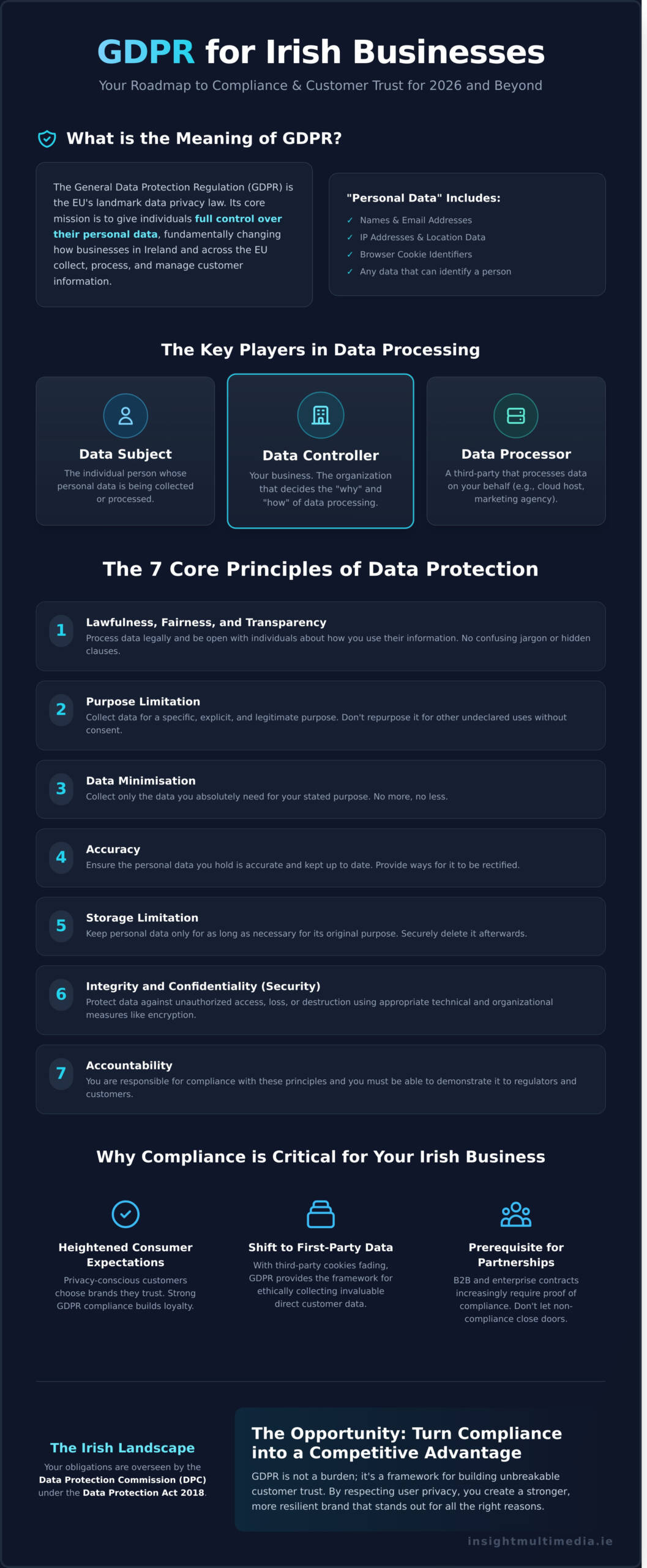
For any modern Irish business, understanding the gdpr meaning is not just a legal formality; it is a cornerstone of building customer trust and a competitive digital strategy. At its core, the General Data Protection Regulation (GDPR) is the world’s most comprehensive and robust data privacy law. Established by the European Union, its primary goal is to give individuals complete control over their personal data, fundamentally changing how organisations handle the information they collect.
This regulation defines “personal data” in very broad terms, covering anything that can be used to identify a person. This includes obvious details like names and email addresses, but it also extends to digital identifiers such as IP addresses, location data, and browser cookie identifiers. The law’s reach is significant; it applies to any organisation, whether based in Cork, Dublin, or outside the EU, that processes the personal data of individuals residing in the European Union while offering them goods or services.
Key Definitions You Need to Know
To navigate GDPR effectively, it is essential to understand the roles involved. The regulation defines three key parties in the data processing relationship:
- Data Subject: This is the individual person whose personal data is being collected, held, or processed.
- Data Controller: This is the business or organisation (e.g., your company) that determines the purposes and means of processing personal data.
- Data Processor: This is a third-party that processes data on behalf of the controller, such as a cloud hosting provider, a marketing agency, or a payroll company.
Why GDPR Matters in 2026
While GDPR has been in effect for years, its importance is only growing. For ambitious businesses in Galway, Limerick, and across Ireland, compliance is now a critical driver of success for several key reasons:
- Heightened Consumer Expectations: Customers are more privacy-conscious than ever. Demonstrating strong GDPR compliance is a powerful way to build brand trust and loyalty.
- The Shift to First-Party Data: As major browsers phase out third-party cookies, the first-party data you collect directly from your customers becomes invaluable. GDPR provides the framework for collecting this data ethically and effectively.
- A Prerequisite for Partnerships: Professional B2B partnerships and enterprise contracts increasingly require all parties to be fully GDPR compliant. Non-compliance can close doors to valuable business opportunities.
The Seven Core Principles of Data Protection
To truly understand the GDPR meaning, Irish businesses must get to grips with its seven core principles. These are not just vague guidelines; they are the fundamental rules that govern how you collect, process, and store personal data. For businesses in Dublin, Cork, and across Ireland, embedding these principles into your daily operations is the key to building customer trust and ensuring compliance.
The regulation is built upon these foundational concepts:
- Lawfulness, Fairness, and Transparency: You must have a valid legal basis for processing data and be completely open with individuals about how you use it. No hidden clauses or confusing jargon.
- Purpose Limitation: Data collected for one specific purpose, like a newsletter signup, cannot be used for another, such as market research, without obtaining separate consent.
- Data Minimisation: Only collect the personal data you absolutely need to achieve your stated purpose. If you are sending an email newsletter from your office in Limerick, you likely do not need a person’s home address.
- Accuracy: You are responsible for ensuring the personal data you hold is accurate and, where necessary, kept up to date. You must take every reasonable step to erase or rectify inaccurate data.
- Storage Limitation: Once you no longer need the data for its original purpose, you must securely delete it. Hoarding data “just in case” is a direct violation of this principle.
Integrity and Confidentiality
This sixth principle is all about security. It mandates that you protect personal data from internal and external threats. For any modern business in Galway or Waterford, this means robust technical measures like data encryption and secure web hosting are non negotiable. At its core, integrity is the protection against unauthorised or unlawful processing and against accidental loss, destruction, or damage.
The Accountability Principle
The final principle is a crucial part of the modern GDPR meaning: you are responsible for compliance and you must be able to demonstrate it. It is not enough to simply follow the rules; you must prove you are doing so. This involves maintaining clear records of your data processing activities, a requirement detailed by the Irish Data Protection Commission. Comprehensive staff training and clear internal data policies are also vital for showing your commitment.
GDPR in Ireland: Navigating the Local Landscape
For businesses across Ireland, from bustling hubs in Dublin and Cork to regional centres, understanding the local application of data protection law is critical. The gdpr meaning is not just a European directive; it is enforced locally and supplemented by national legislation. Every Irish business must operate under both the GDPR and Ireland’s own Data Protection Act 2018. This dual framework is overseen by a powerful national authority, ensuring that compliance is not an option but a fundamental business requirement.
In recent years, the focus on compliance for small and medium sized enterprises has intensified. Local regulations also affect specific activities, such as how businesses in Galway and Limerick must approach consent for direct marketing communications. Staying ahead of these local nuances is key to avoiding serious penalties.
The Role of the Data Protection Commission
The Data Protection Commission (DPC) is the national supervisory authority responsible for upholding data protection rights in Ireland. They are the body that investigates complaints from citizens, conducts audits, and has the power to issue corrective orders and substantial fines. For businesses in counties like Waterford and Tipperary, proactively engaging with the DPC’s resources is essential. Staying informed through the Official GDPR Guidance from the Data Protection Commission is the first step toward building a robust and defensible compliance strategy.
Fines and Penalties for Irish SMEs
The consequences of non-compliance are designed to be a serious deterrent. Irish SMEs must be aware that they are not exempt from enforcement. The potential penalties are severe and can have a lasting impact on your business.
- Substantial Fines: Penalties can reach up to €20 million or 4% of your company’s annual global turnover, whichever is higher.
- Reputational Damage: A publicised data breach or fine can destroy customer trust, often causing more long term damage than the financial penalty itself.
- No Exemptions for Size: Small businesses are frequently investigated and fined. The DPC has made it clear that every organisation handling personal data has a duty of care.
Website Compliance Checklist: A Practical Guide
Understanding the core GDPR meaning is the first step; the next is putting it into practice on your website. For any Irish business with an online presence, from a startup in Limerick to an established brand in Dublin, website compliance is non-negotiable. This practical checklist covers the essential areas you must address to protect your users and your business.
- Audit Your Data Collection: Conduct a complete review of all personal data your website gathers. This includes contact forms, newsletter signups, e-commerce transactions, and analytics. You need to know precisely what you collect, why you need it, and how it is stored.
- Update Your Privacy Policy: Your privacy policy must be transparent, easy to find, and written in plain English. Avoid complex legal jargon. It should clearly explain what data you process, your legal basis for doing so, and how users can exercise their rights.
- Implement Compliant Cookie Consent: A robust cookie banner is essential. It must block all non-essential cookies by default, including those for marketing and analytics. Users must give explicit, affirmative consent before these cookies are activated.
- Secure All User Forms: Every form on your website must be secured with SSL encryption, indicated by ‘https’ in the URL. For marketing communications, use unticked checkboxes so that users have to actively opt in. Pre-ticked boxes are not compliant.
- Ensure Secure Hosting & Maintenance: Your responsibility for data protection extends to your website’s infrastructure. Work with a web design agency that provides secure, reliable hosting and performs regular security maintenance to protect against vulnerabilities.
Privacy by Design in Web Development
True GDPR compliance is not an afterthought; it is a foundational principle of modern web development. ‘Privacy by Design’ means integrating data protection into your website from the very first line of code. A bespoke web design gives you far greater control over data flows than many off the shelf solutions. At Insight Multimedia, we build eye-catching websites for clients from Cork to Galway that prioritise user privacy without ever sacrificing the stunning design your brand deserves.
Managing Third-Party Integrations
Many websites rely on third-party tools, and you are responsible for their compliance. You must audit every integration, from Google Analytics and Facebook Pixels to your e-commerce payment gateway. Ensure your email marketing software, like Mailchimp, uses GDPR-compliant signup processes. As the data controller, you are ultimately accountable for the data processing activities of the tools you choose to embed on your site.
Getting your website right is a crucial part of demonstrating you understand the true GDPR meaning and respect your customers’ data. For businesses across Ireland who want a website that not only looks incredible but is also compliant and converts, expert guidance is key. Speak with our team to ensure your digital presence is both secure and successful.
Building Trust: Why Compliance is Good for Business
For smart Irish businesses, GDPR is far more than a set of rules to follow; it is a powerful opportunity to build customer trust and create a significant competitive advantage. Understanding the true gdpr meaning in a commercial context is about shifting your perspective from obligation to opportunity. When you treat customer data with respect, you are not just avoiding fines, you are building a stronger, more resilient brand.
Customers from Dublin to Galway are increasingly aware of their data rights. They are far more likely to engage with and share information with brands they trust to handle it responsibly. This transparent approach is the bedrock of modern digital marketing, creating a loyal customer base that willingly provides the high-quality data needed for effective campaigns. In short, good privacy practices lead directly to better business intelligence.
This commitment to privacy must be reflected in your digital storefront. A stunning, high-quality website paired with a confusing or non-compliant cookie banner sends mixed signals. GDPR compliance is the foundation of a professional digital presence, proving to visitors that you value excellence in every aspect of your operations.
Refuse to Blend In with Superior Privacy Standards
In a crowded marketplace, you can stand out by making data protection a core part of your brand identity. Instead of hiding your privacy policy, use it as a marketing strength that demonstrates your commitment to your customers. With creative branding and clear communication, even legal notices can be transformed into engaging assets that reinforce your brand’s trustworthy character, helping you to connect with clients in Cork, Limerick, and beyond.
The Future of Privacy-First Marketing
Investing in robust compliance now is a strategic move that prepares your business for the future of digital regulation. The trend towards greater user privacy is only accelerating. By building strategies around zero-party data-information that customers intentionally and proactively share with you-you create a sustainable and highly effective marketing model for a privacy-first world. This is the key to genuine customer relationships.
Ensure your digital presence is both beautiful and compliant from day one. Contact Insight Multimedia today to discuss how our end-to-end web design and digital marketing services can build a powerful, professional, and trustworthy platform for your brand.
Beyond Compliance: Turning GDPR into a Competitive Advantage
As we look towards 2026, it is clear that the true gdpr meaning for businesses across Ireland is about far more than just avoiding fines. It represents a foundational framework for building lasting customer trust and a powerful signal of your brand’s integrity. By embedding the seven core principles into your operations and maintaining a compliant digital presence, you transform a legal obligation into a genuine competitive advantage that resonates with today’s data-conscious consumer.
For over 20 years, our award-winning creative studio, with teams in both Cork and Dublin, has empowered brands to stand out securely. We deliver comprehensive, end-to-end solutions, from initial design to ongoing secure website maintenance, ensuring your digital storefront is both beautiful and compliant. Ready to build a website that performs and protects? Refuse to blend in and secure your brand with our custom web design and compliance services. Let’s build your standout digital future, together.
Frequently Asked Questions
What is the main meaning of GDPR for a small business in Ireland?
For a small business in Ireland, the core gdpr meaning is about transparency, accountability, and building customer trust. It requires you to lawfully process, secure, and manage personal data. This means clearly explaining why you collect customer information, getting valid consent, and only keeping it for as long as is strictly necessary. It’s a framework that empowers your customers and enhances your business’s reputation, whether you operate from a small office in Tipperary or a large storefront in Dublin.
Do I need a Data Protection Officer (DPO) for my Irish company?
Most Irish SMEs are not legally required to appoint a Data Protection Officer. The obligation applies mainly to public authorities or organisations whose core activities involve large-scale, systematic monitoring of individuals or processing sensitive data. However, even if not mandatory for your Cork-based business, it is best practice to assign responsibility for data protection to a specific person. This ensures consistent oversight and accountability for handling customer information correctly and securely.
Is a simple cookie banner enough to be GDPR compliant?
No, a simple cookie banner stating ‘we use cookies’ is not enough for GDPR compliance in Ireland. A compliant banner must obtain explicit and granular consent before any non-essential cookies are activated. This means users must be given a clear choice to accept or reject different categories of cookies, such as analytics or marketing. Pre-ticked boxes are forbidden. Your website must provide clear information and make it just as easy to reject cookies as it is to accept them.
How long can I legally store customer data under GDPR rules?
Under GDPR, there is no single fixed time for storing customer data. The rule is ‘storage limitation’, meaning you can only keep personal data for as long as necessary for the specific purpose it was collected. For example, you might need to keep invoice data for six years to comply with Revenue requirements in Ireland. Once that legal or business purpose has expired, the data must be securely and permanently deleted from your systems, whether they are in Waterford or Galway.
What happens if my business suffers a data breach in Ireland?
If your Irish business suffers a data breach, you have a legal duty to act quickly. You must notify Ireland’s Data Protection Commission (DPC) without undue delay, and where feasible, within 72 hours of becoming aware of the breach. If the breach is likely to result in a high risk to individuals’ rights, such as identity theft, you must also inform the affected customers directly. Prompt and transparent action is crucial to mitigate damage and meet your legal obligations.
Alongside legal reporting, it’s crucial to investigate the source and extent of the breach to prevent future incidents. For complex situations requiring professional analysis, you may need to engage specialists; to see what that involves, you can check out International Investigative Group.
Does GDPR apply if I only sell to customers in Cork and Dublin?
Yes, GDPR absolutely applies even if you only sell to customers within Cork and Dublin. The regulation protects the personal data of any individual residing in the European Union, regardless of your business’s location or market reach. Because your customers are in Ireland, they are fully protected by GDPR. The rules are based on the location of the person whose data is being processed, not the geographical scope of your sales activities.
Can I still use Google Analytics on my website under GDPR?
Yes, you can still use Google Analytics on your website, but you must do so in a GDPR compliant manner. This requires getting explicit user consent before the tool activates and places cookies on their device. This is managed through a compliant cookie consent banner. You should also enable IP anonymisation within your Google Analytics settings and clearly disclose your use of the tool, and the data it collects, within your website’s privacy policy.
How much does it cost to make a website GDPR compliant in 2026?
The cost to make a website GDPR compliant in 2026 can vary significantly. For a basic informational website, implementing a compliant cookie banner and privacy policy might cost between €500 and €1,200. For a more complex e-commerce or lead generation site in Dublin, requiring a detailed data audit, implementation, and staff training, the investment could range from €2,000 to over €5,000. The final price depends entirely on your site’s complexity and data processing activities. Beyond the initial setup, managing ongoing compliance requires careful financial planning, and many businesses seek guidance from firms like Reflechir Consultancy to ensure their overall business strategy effectively incorporates these kinds of regulatory costs.
Related Posts