
What is Digital Marketing? The Ultimate Guide for Irish Businesses
For many Irish business owners, the world of digital marketing can feel like a confusing maze of acronyms and ever-changing trends. You know you need to be online to grow, but the fear of wasting your hard-earned budget on strategies that don’t deliver real business is a major hurdle. It’s a common feeling: you’re ready for your brand to stand out, but you’re not sure which direction to turn first or how to connect all the moving parts into a cohesive plan.
This is where that changes. Consider this your ultimate guide, created to cut through the noise and provide absolute clarity. We’ll break down exactly what digital marketing involves, explore the core channels that deliver tangible results for businesses across Ireland, and give you a simple framework to build a powerful strategy. By the end, you’ll have the confidence to invest wisely, choose the right path for your brand, and understand how to turn your online presence into your most powerful asset for growth.
Key Takeaways
- Learn why an online presence is no longer optional, acting as your 24/7 digital storefront for Irish customers.
- Get a simple, 4-step framework to build your first digital marketing strategy, moving from confusion to a clear, actionable plan.
- Understand why your website is the engine of all your marketing-the central hub that must be designed to convert visitors into real business.
- Gain clarity on whether to manage marketing in-house or when partnering with an agency is the smarter investment for growth.
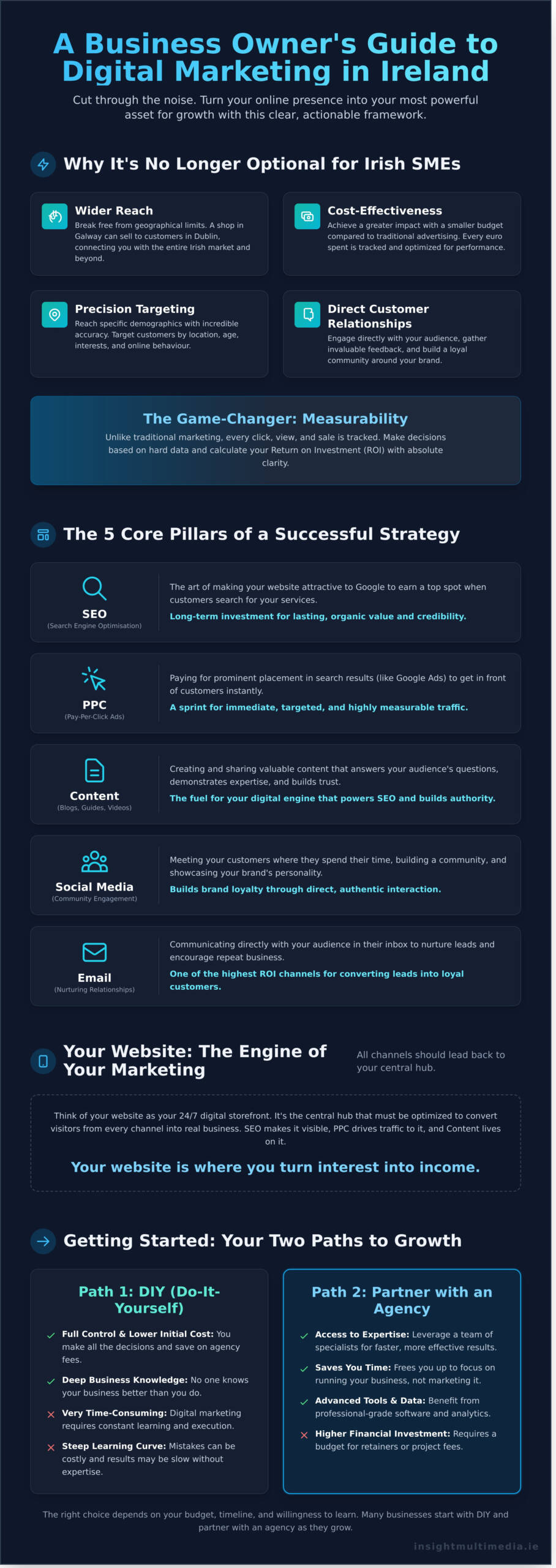
What is Digital Marketing (And Why Should Your Irish Business Care?)
Imagine your business has a prime spot on Grafton Street, with thousands of potential customers walking past every day. That’s what effective digital marketing does for your brand, but on the internet. It’s not a dark art reserved for global corporations; it’s the essential practice of meeting your customers where they already spend their time: on Google, scrolling through social media, and checking their email. For Irish SMEs who refuse to blend in, it’s the most powerful tool for growth in today’s market.
A Plain English Definition for Business Owners
At its core, digital marketing is the use of online channels-like search engines, social media, and email-to promote and sell your products or services. Unlike traditional marketing, which might involve a newspaper ad or a radio spot, this approach is dynamic and interactive. The ultimate goal isn’t just to be seen; it’s to build a system that consistently attracts the right audience, engages them with compelling content, and converts them into loyal customers for your business.
The Core Benefits for Small and Medium Irish Businesses
For SMEs across Ireland, from Cork to Dublin, the advantages are transformative. This isn’t just about having a website; it’s about turning that website into a lead-generating machine. Key benefits include:
- Wider Reach: Instantly break free from geographical limits. A shop in Galway can sell to customers in Dublin or even further afield with a targeted campaign.
- Cost-Effectiveness: Achieve a greater impact with a smaller budget compared to traditional advertising, ensuring every euro is spent wisely.
- Precision Targeting: Reach specific demographics with incredible accuracy-targeting by location, age, interests, and online behaviour.
- Direct Customer Relationships: Engage directly with your audience, gather invaluable feedback, and build a community around your brand.
Measurability: The Key Advantage Over Traditional Marketing
The true game-changer is data. While you can only guess how many people saw your flyer, digital marketing tracks everything. Every click, every page view, and every sale is recorded. This allows you to make decisions based on hard evidence, not intuition. It means you can calculate your Return on Investment (ROI) with clarity, understanding exactly which strategies are delivering real business conversions and which need refinement.
The 5 Core Pillars of a Successful Digital Marketing Strategy
A powerful digital marketing strategy is much like a well-built structure; it relies on several core pillars working in unison to support your business goals. While you don’t need to master all of them from day one, understanding how they connect is key to sustainable growth. Think of them as specialised tools in your kit: Search Engine Optimisation (SEO) for organic visibility, Pay-Per-Click (PPC) for immediate reach, Content Marketing to build authority, Social Media for community engagement, and Email Marketing to nurture relationships. When integrated, these pillars don’t just generate traffic; they create a system that attracts, engages, and converts customers. The benefits of digital marketing are particularly impactful for Irish SMEs, allowing them to compete on a larger stage.
Search Engine Optimisation (SEO): Getting Found on Google
At its core, SEO is the art and science of making your website more attractive to search engines like Google. The objective is simple but powerful: to appear on the first page when potential customers in Ireland search for your products or services. This isn’t about paying for a top spot; it’s about earning it through technical improvements, relevant content, and building authority. SEO is a long-term investment that builds lasting, organic value and credibility for your brand.
Pay-Per-Click (PPC) Advertising: Immediate, Targeted Traffic
Where SEO is a marathon, PPC is a sprint. Platforms like Google Ads allow you to pay for prominent placement in search results, putting your business in front of customers the moment you launch a campaign. The key advantages are speed and precision; you can target users based on location, demographics, and search terms. Crucially, as the name suggests, you only pay when someone actually clicks on your ad, making it a highly measurable and controllable way to drive traffic. If you’re interested in data-driven paid advertising, you can check out HOT IRON Digital to see how performance marketing agencies approach it.
Content Marketing: Building Trust and Answering Questions
Content marketing is the fuel that powers your entire digital engine. It involves creating and sharing valuable, relevant content-such as blog posts, guides, and videos-that answers your audience’s questions. This isn’t a direct sales pitch; it’s about demonstrating your expertise and building trust. High-quality content is essential for a successful SEO strategy and provides the material you need to engage your audience on social media, establishing your brand as a go-to authority.
High-quality video, in particular, has become a powerful tool for storytelling and engagement. For those interested in how a cohesive suite of creative services can elevate a brand, you can <learn more about AHS Digital>(https://ahsdigital.co.uk/ahsdigital-videography/).
Social Media Marketing: Engaging With Your Community
Social media is your brand’s public-facing personality. It’s less about direct selling and more about building a community and starting conversations. For Irish businesses, platforms like Instagram, Facebook, and LinkedIn offer powerful ways to connect with customers directly. Use it to showcase your company culture, provide real-time customer service, and share the brilliant content you’ve created. It’s where your brand stops being a logo and starts being a voice.
Email Marketing: Nurturing Leads and Driving Repeat Business
Email marketing remains one of the most effective digital channels because it offers a direct line to your most engaged audience-people who have actively chosen to hear from you. It is the perfect tool for nurturing leads from interest to conversion and for encouraging customer loyalty. Through newsletters, exclusive offers, and automated campaigns, you can build lasting relationships and drive significant repeat business, delivering a fantastic return on investment.
How to Build Your First Digital Marketing Strategy: A 4-Step Framework
Understanding the components of digital marketing is crucial, but building a cohesive strategy is what separates activity from achievement. A clear plan prevents you from wasting time and your hard-earned budget on channels that don’t deliver. It ensures every action you take is a deliberate step towards a defined goal. This is how we think, and it’s how we empower our clients to build brands that refuse to blend in.
Follow this simple framework to lay the foundations for a powerful digital marketing engine that drives real business conversions.
Step 1: Define Your Business Goals (What Do You Want to Achieve?)
Before you think about channels or content, start with your core business objective. What does success look like for you? Is it more leads through your website, a 15% rise in online sales, or more phone calls to your Dublin office? Translate these broad ambitions into specific, measurable marketing goals. For example, “Increase qualified leads via our contact form by 25% in Q3” is a powerful target; “get more leads” is not.
Step 2: Understand Your Ideal Irish Customer
You can’t connect with an audience you don’t understand. Create a simple profile of your ideal customer. Who are they? Are they a tech-savvy SME owner in Galway or a fashion-conscious student in Limerick? Where do they spend their time online-LinkedIn, Instagram, or specific forums? Understanding their problems and online behaviour is the key that unlocks which channels and messages will actually resonate with them.
Step 3: Choose the Right Channels (You Don’t Need to Be Everywhere)
The biggest mistake businesses make is trying to be active on every platform. Your customer research from Step 2 should guide your focus. Your goal is to be present where it matters most.
- A B2B consultant might focus on generating authority through SEO and networking on LinkedIn.
- A bustling local café in Cork will find more success with visual storytelling on Instagram and managing reviews on its Google Business Profile.
Step 4: Measure What Matters
A strategy without measurement is just a guess. You must track your performance to understand what’s working. Start with the basics: website traffic, conversion rate (the percentage of visitors who take a desired action), and cost per lead. Free tools like Google Analytics are essential, acting as the dashboard for your digital engine. Regularly reviewing these numbers allows you to refine your approach, ensuring your efforts align with proven digital marketing strategies and best practices. This iterative process of measuring, learning, and adjusting is what drives sustainable growth.
Your Website: The Engine Room of Your Digital Marketing
Every component of your digital marketing strategy-from a clever social media campaign to a top-ranking Google result-has one ultimate destination: your website. It’s the engine room where interest is converted into action, the central hub that powers your entire online presence. A powerful, high-performance website drives business growth; a poor one wastes every cent of your marketing budget and effort.
Why All Roads Lead Back to Your Website
Think of your online presence as a hub-and-spoke model. Your website is the central hub, the one digital property you completely own and control. Social media platforms and search engines are the spokes-valuable channels for driving traffic, but you don’t own the platform or the rules. Your website is where potential customers truly get to know your brand, explore your services, and most importantly, where conversions happen. It’s your permanent digital headquarters.
The Role of Professional Web Design in Marketing Success
A professional web design does more than just look good; it builds instant credibility and trust. For brands that refuse to blend in, a stunning, original design is non-negotiable. But performance is just as critical. Key factors that impact your bottom line include:
- Site Speed: Slow-loading pages frustrate users and harm your Google rankings.
- Mobile-Friendliness: With most users in Ireland browsing on their phones, a responsive design is essential for user experience and SEO.
- Clear Navigation: An intuitive layout guides visitors smoothly towards making an enquiry or a purchase.
Ultimately, a website must be meticulously designed to convert visitors into loyal customers.
An Integrated Example: How It All Works Together
Imagine a homeowner in Cork searching Google for “custom kitchen design” (SEO). They click on your blog post, “5 Kitchen Trends for Irish Homes,” and find it valuable (Content Marketing). Later, they see a visually striking ad on Facebook showcasing your recent projects (PPC/Social Media Retargeting). They click the ad, return to your beautiful, fast-loading website, and fill out your contact form to request a consultation. Every channel worked in harmony, but the final, crucial conversion happened on the one asset you control completely.
This seamless integration is the hallmark of effective marketing. But it all falls apart if the final step-the website experience-is weak. Does your website convert traffic into business? Let’s talk.
Getting Started: DIY vs. Hiring a Digital Marketing Agency
Once you understand the core components of digital marketing, the next logical question is: “Should I do this myself or hire professionals?” This is a critical strategic decision that depends entirely on your current resources, long-term goals, and appetite for growth. There’s a valid case for both paths, but understanding the trade-offs is key to making the right choice for your business.
When to Consider the DIY Approach
For brand new start-ups and sole traders, where time is more plentiful than budget, a DIY approach can be a practical starting point. The key to success here is focus. Instead of trying to master everything at once, concentrate on learning one or two channels that will have the most impact. This could be building a local presence with Google Business Profile or engaging a niche audience on Instagram. Be prepared, however, for a steep learning curve and a significant time commitment that takes you away from your core business operations.
The Benefits of Partnering with an Agency
Hiring an agency is not an expense; it’s a strategic investment in accelerating your growth. When you partner with a professional team, you gain immediate access to a wealth of resources that are difficult and costly to build in-house. The advantages are clear and compelling:
- A Team of Specialists: You instantly have experts in SEO, PPC, content creation, and social media strategy working on your behalf.
- Time is Your Most Valuable Asset: Outsourcing allows you to reclaim countless hours, letting you focus on running and growing your business.
- Industry Tools & Expertise: Agencies invest tens of thousands of Euro in cutting-edge software and have the experience to extract maximum value from it.
For those considering this path, exploring how different agencies position themselves can be insightful; for instance, you can learn more about The Palm Group, an agency that focuses on building performance-focused digital communication systems.
What to Look For in an Irish Digital Marketing Partner
When choosing an agency, look for a true partner, not just a supplier. The right team will be obsessed with your business goals-leads, sales, and tangible ROI-not just vanity metrics. They should proudly showcase a portfolio of work and case studies with Irish clients, demonstrating a deep understanding of the local market. Critically, seek out an agency with a full-service, in-house team. This ensures every element of your strategy is seamlessly integrated, creating powerful campaigns that don’t just look good, but perform and convert. See how our integrated approach has helped Irish businesses grow.
From Insight to Impact: Your Digital Marketing Journey Starts Now
We’ve explored how a robust strategy is no longer a luxury but a necessity for Irish businesses hoping to thrive online. The key takeaways are clear: success is built on a foundation of core pillars, powered by a high-performing website, and guided by a clear plan. The final decision-whether to navigate this complex landscape yourself or partner with a seasoned expert-is the crucial next step that will define your growth.
For over 20 years, Insight Multimedia has been the end-to-end partner for Irish brands that refuse to blend in. Our award-winning creative web design and results-driven digital marketing strategies are crafted in-house by our teams in both Cork and Dublin. We don’t just build stunning websites; we build engines for business growth that convert and deliver tangible results.
Ready to grow your business? Talk to our digital marketing experts today.
Frequently Asked Questions About Digital Marketing
How much does digital marketing cost for a small business in Ireland?
The cost varies based on your goals and the services required. For a small to medium-sized business in Ireland, a monthly retainer for a comprehensive digital marketing strategy typically ranges from €750 to over €2,500. This investment covers expertise in areas like SEO, PPC, and content creation. The final figure depends on the scope and aggressiveness of the campaign, but it should always be viewed as a direct investment in generating tangible business growth and conversions.
How long does it take to see results from digital marketing?
The timeline for results depends on the channel. Paid advertising campaigns, such as Google Ads (PPC), can generate traffic and leads almost immediately. In contrast, SEO is a long-term investment in building authority and organic visibility. You can expect to see meaningful traction and a significant increase in organic traffic within 4 to 6 months of consistent, expert effort. A balanced strategy delivers both short-term wins and sustainable, long-term growth.
What is the difference between SEO and SEM?
This is a common point of confusion. Search Engine Marketing (SEM) is the broad discipline of gaining website traffic from search engines; it is the umbrella term. Search Engine Optimisation (SEO) is a major component of SEM that focuses specifically on gaining organic, or unpaid, traffic. SEM also includes paid tactics, most notably Pay-Per-Click (PPC) advertising. In short, SEO is the organic side of SEM, while PPC is the paid side.
Which social media platform is best for my business?
The best platform is always the one where your target customers spend their time. For businesses with highly visual products or services aimed at consumers (B2C), platforms like Instagram and Facebook are often ideal. For B2B companies focused on professional services, LinkedIn is the undisputed leader for building authority and connecting with decision-makers. The key is to choose strategically and create high-quality content that resonates, rather than trying to be everywhere at once.
Do I really need a blog for my business website?
Yes, a blog is one of the most powerful tools in your digital arsenal. It is the engine of your content marketing and SEO strategy. Regularly publishing high-quality, relevant blog posts helps you rank for more keywords, demonstrates your expertise, and answers the questions your potential customers are asking. This builds trust, drives qualified organic traffic to your website, and ultimately converts visitors into real business leads for your company.
What is more important: SEO or PPC?
Neither is inherently “more important”; they are two sides of the same coin and work best together. PPC delivers immediate, targeted traffic and is perfect for testing offers and generating quick leads. SEO builds long-term credibility, sustainable organic traffic, and a powerful brand presence that pays dividends over time. A truly effective digital marketing strategy integrates both, using PPC for immediate impact while SEO builds a lasting foundation for growth.
Related Posts