
What Is a Domain Name (And How Do You Choose the Perfect One?)
Choosing the digital address for your Irish business-your domain name-is one of the most important first steps you’ll take online. Yet, it’s often a source of confusion. You’re faced with technical jargon like DNS and hosting, the pressure to pick a name that won’t hurt your brand, and the big question: should you go for a .ie or a .com? It’s enough to make anyone feel overwhelmed before they’ve even started.
This analogy holds true for all types of businesses. For example, a company that specializes in physical buildings, such as offering Custom Home Construction, still needs a well-constructed digital “building”—their website—to attract clients and showcase their work.
At Insight Multimedia, we’ve spent over two decades helping businesses in Cork, Dublin, and across Ireland build stunning websites that don’t just look good; they convert. We believe that securing the right digital foundation is essential for any brand that refuses to blend in. This guide is designed to cut through the noise. We’ll explain exactly what a domain is, how it works, and provide a clear, step-by-step process for choosing and registering the perfect one for your business, ensuring you start your online journey with confidence and clarity.
Key Takeaways
- Understand that your domain name is more than a technical detail; it’s your business’s permanent digital address and a core brand asset.
- Learn the key principles for choosing a memorable, brand-aligned domain that is easy for your Irish customers to find and type.
- Discover the simple, step-by-step process to search for, select, and purchase your ideal name through a certified registrar.
- Uncover the difference between extensions like .ie and .com and learn how to select the right one to build trust and target your specific market.
Demystifying the Domain Name: Your Business’s Digital Address
Before diving into the creative process of choosing a name, it’s essential to understand exactly what a domain is and its crucial role in your online strategy. Think of your domain name as the unique street address for your business on the internet. It’s the memorable, easy-to-type name like insightmultimedia.ie that customers enter into their browser to find you. Its primary function is to make your website accessible to the world, creating a professional and permanent home for your brand online.
On a technical level, a domain name is a human-friendly label that translates a website’s complex, numeric Internet Protocol (IP) address into simple words. To understand the full technical background, it’s helpful to ask What is a domain name?, but for business purposes, all you need to know is that it’s the critical first step in building a credible digital presence. It’s often confused with a website or hosting, but these three elements are distinct, yet work together.
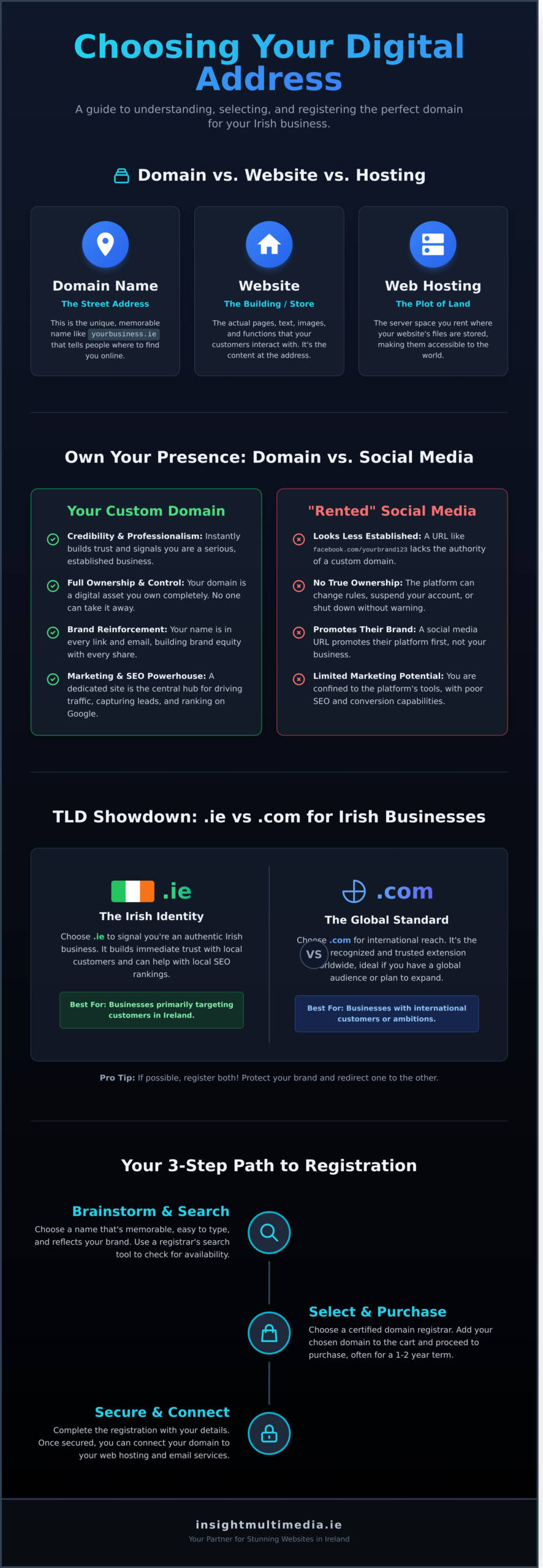
Domain vs. Website vs. Hosting: A Simple Breakdown
Understanding the difference between these three core components is fundamental. Each plays a specific role in bringing your business to life online. We use a simple property analogy to make it crystal clear.
| Component | Property Analogy | Function |
|---|---|---|
| Domain Name | The Street Address | Tells people where to find you (e.g., yourbusiness.ie). |
| Website | The Building / Store | The actual content customers see: pages, text, images, and functions. |
| Web Hosting | The Plot of Land | The server space where your website’s files are stored and made accessible. |
Why You Can’t Just Use a Social Media Profile
While a strong social media presence is vital, it can never replace a dedicated website with its own domain name. Relying solely on a platform like Instagram or Facebook puts your brand on “rented land” and limits your potential. Here’s why securing your own domain is non-negotiable:
- Credibility and Professionalism: A custom domain (e.g., yourbrand.ie) instantly builds trust and signals that you are a serious, established business. A URL like facebook.com/yourbrand123 simply doesn’t have the same authority.
- Ownership and Control: You don’t own your social media page. The platform can change its rules, suspend your account, or even shut down, potentially erasing your online presence overnight. Your domain is an asset you own and control completely.
- Branding: Your domain name is a cornerstone of your brand identity. It reinforces your name in every link you share and every email you send, unlike a generic social media URL that promotes their brand first.
- Marketing and SEO: A dedicated website is the foundation for all serious digital marketing, especially Search Engine Optimisation (SEO). It’s the central hub where you drive traffic, capture leads, and convert customers-something a social profile cannot do effectively.
How to Choose a Domain Name That Boosts Your Brand
Selecting a domain name is far more than a simple technical step in setting up a website; it’s a critical business decision that lays the foundation for your entire online identity. Think of it as a long-term asset, the digital equivalent of your physical storefront. A great domain builds brand equity, inspires confidence, and makes you memorable. The goal is to find the perfect balance between a creative name that helps you stand out and a clear, simple name that customers can easily find and recall. Getting this right from the start prevents costly rebranding efforts down the line and avoids common mistakes that can hinder your growth.
Characteristics of a Strong Domain Name
Your domain name is the cornerstone of your digital brand. To ensure it performs effectively, it should be built on a few key principles. A strong domain is intuitive for users and professional in its presentation. Choosing the right extension, like a .ie for the Irish market or a .com for global reach, is also vital. Understanding the basic structure of domain names can help you make a more strategic choice. Here are the core characteristics:
- Short, Simple, and Easy to Spell: Long or complex names are easily misspelled, leading potential customers to error pages or, even worse, a competitor’s site.
- Memorable and Easy to Pronounce: Your domain should pass the “radio test.” If you can say it aloud and a listener can easily understand and type it, you have a winner.
- Reflects Your Brand or Service: It should immediately signal who you are or what you do. Your business name is almost always the best option.
- Avoids Hyphens and Numbers: These are difficult to communicate verbally (e.g., “the number 5 or the word five?”) and are often associated with spammy websites. Keep it clean and alphabetic.
Brainstorming Your Perfect Domain
Finding an available domain that ticks all the boxes requires a bit of creativity and strategic thinking. Start with your top choices and work through alternatives if they are already taken. Here’s a simple process to guide your brainstorming:
- Start with Your Business Name: This is the most direct and brand-friendly option. If
YourBusiness.ieis available, register it immediately. - Use Keywords: If your brand name is taken, consider adding a keyword related to your industry or location. For example, a Cork-based design firm might try
CorkDesignStudio.ie. - Try Domain Generators: Online tools can offer creative suggestions by combining your keywords with common prefixes and suffixes. They are excellent for sparking new ideas.
- Check Social Media: Before you finalise your purchase, check if the corresponding name is available as a handle on major social media platforms to ensure brand consistency.
SEO Considerations for Your Domain
While the direct impact of keywords in a domain name has diminished, your choice still influences your SEO. Years ago, an “exact match domain” like BestWebDesignDublin.ie offered a significant ranking boost. Today, search engines like Google are far more sophisticated. They prioritise brandability and user experience over keyword-stuffing. A unique, memorable domain is seen as a stronger brand signal, which builds trust and authority over time. Furthermore, the age and history of a domain can be a minor factor; an older domain with a clean, consistent history is often viewed more favourably by search engines than a brand-new one.
The Step-by-Step Guide to Registering Your Domain Name
Once you’ve chosen the perfect name, the next step is to officially register it. This process secures your unique address on the internet, making it exclusively yours. While it may seem technical, registering your chosen domain is a straightforward process when broken down into a few key steps. It’s the foundational move that turns your brand vision into a tangible digital asset.
Step 1: Choosing a Domain Registrar
A domain registrar is an ICANN-accredited company that manages the reservation of internet domain names. Think of them as the official shop where you purchase and manage your web address. For businesses in Ireland, popular choices include Register365 and LetsHost, alongside global players like GoDaddy.
- Look for Transparency: Choose a registrar with clear, upfront pricing. Be wary of low initial costs that hide high renewal fees or aggressive upsells for services you don’t need.
- Expert Handling: As a full-service digital agency, we often handle this entire process for our clients, ensuring a seamless setup from the very start.
Step 2: Searching and Selecting Your Domain
Every registrar’s website features a prominent search bar. Use this to confirm your desired name is available. If it’s taken, the tool will often suggest creative alternatives. Once you find an available name you love, you’ll need to select a registration period-typically from one to ten years. A longer registration can sometimes offer a better price and signals to search engines that you’re committed to your project. Add your final choice to the cart to proceed.
Step 3: Completing the Purchase and Configuration
To finalise your purchase, you’ll provide contact details (name, address, email) for the public WHOIS record. This is a mandatory step. Here, you’ll face a few important choices:
- Domain Privacy: For a small annual fee (often around €10-€15), you can add WHOIS privacy protection. This service masks your personal information in the public directory, replacing it with the registrar’s details to prevent spam and protect your privacy. We highly recommend it.
- Auto-Renewal: Always enable auto-renewal. Letting a domain expire, even by accident, can be disastrous for your business and expensive to recover.
Once you complete the payment, you are the official owner of the domain! The registrar will send a confirmation email with details on how to manage your new asset. From here, you can connect it to your website hosting and set up professional email addresses.
Feeling overwhelmed by the technical details? Let our team handle the entire process for you. We ensure your digital foundation is built correctly from day one.
Beyond the .com: Understanding Domain Extensions (TLDs)
Choosing your business name is only half the battle; the extension that follows it-the part after the dot, known as the Top-Level Domain (TLD)-is a critical branding decision for your new domain. This small suffix tells customers where you’re based, what you do, and even how established you are. TLDs are broadly categorised into generic TLDs (gTLDs) like .com, country-code TLDs (ccTLDs) like .ie, and a new wave of creative TLDs.
.ie vs .com: What’s Best for an Irish Business?
For any business operating in Ireland, this is the primary decision. A .ie extension instantly signals your connection to Ireland, building immediate trust and credibility with a local audience. It also provides a tangible SEO advantage, as search engines often prioritise .ie results for users searching within Ireland. In contrast, .com is the undisputed global standard, projecting an international presence. It’s the default choice for businesses with ambitions beyond Irish shores. Our recommendation is clear: secure the .ie first to establish your local identity. If available, register the .com as well to protect your brand for future growth.
Other Common TLDs (Top-Level Domains)
While .ie and .com are the heavyweights, other established TLDs serve specific purposes and can be powerful alternatives:
- .org: The traditional choice for non-profits, charities, and community organisations.
- .co: A popular, shorter alternative to .com, often adopted by startups and tech companies for its modern feel.
- .net: Originally intended for network and internet infrastructure companies, it’s now a more general-purpose option.
The Rise of New and Creative TLDs
In recent years, hundreds of new TLDs have emerged, offering industry-specific options like .design, .photography, or .store. While these can be memorable and help your brand stand out, they come with a risk. They lack the built-in trust and recognition of traditional TLDs, which can make some users hesitant. For most professional businesses, we advise sticking with a proven extension to project authority and stability.
Ultimately, your choice of TLD is a strategic asset. To fully protect your brand identity, it’s wise to register multiple key extensions of your chosen name. This prevents competitors or cybersquatters from trading on your hard-earned reputation. Securing your digital footprint is a foundational step in building a powerful online presence. If you need expert guidance on the right strategy, the team at Insight Multimedia is here to help.
You’ve Registered Your Domain… What’s Next?
Congratulations! You’ve successfully secured your digital address-a crucial first step in establishing your online presence. But registering your perfect domain name is just the first piece of the puzzle. Now, it’s time to bring your vision to life by building something remarkable on that digital land.
The next steps involve connecting your new address to a home on the web and ensuring your business communications look professional from the very beginning. Let’s break down what you need to do.
Connecting Your Domain to Web Hosting
Think of your domain as your street address and web hosting as the plot of land where you’ll build. To make your website accessible to the world, you need to connect the two. This is done by updating your domain’s DNS (Domain Name System) records to ‘point’ to your hosting server. In simple terms, the DNS acts like the internet’s phonebook, telling browsers exactly where to find your website when someone types in your address. This is the technical step that makes your website ‘live’.
Setting Up Professional Email
Nothing builds credibility faster than a professional email address. An address like [email protected] instantly communicates trust and legitimacy in a way that a generic Gmail or Eircom address simply can’t. Most quality web hosting packages include the ability to create multiple branded email accounts, giving your business a polished and professional image from day one and reinforcing your brand with every message you send.
Designing and Building Your Website
Your domain is the address; now it’s time to build the house. This is where your brand’s personality, values, and goals are translated into a stunning, high-performance digital experience. A professionally designed website doesn’t just look good-it’s engineered to perform, converting visitors into loyal customers and driving real business growth.
As an end-to-end digital agency with over two decades of experience, this is where we excel. We partner with Irish businesses to create beautiful, original websites for brands who refuse to blend in. We handle every element in-house to ensure your new online home not only captures attention but achieves your most important business objectives.
Ready to build a website that refuses to blend in? Talk to us today.
Your Domain: The Cornerstone of Your Digital Brand
Your domain name is far more than just a web address; it’s the digital front door to your business and a crucial element of your brand identity. Choosing the right one is a strategic decision that sets the stage for your online success, while registering it is the foundational first step in building a powerful web presence. But securing the perfect domain is only the beginning of your journey.
What comes next? Transforming that name into a stunning, high-performing website that captivates customers and drives real business conversions. With over 20 years of experience in Irish web design, our award-winning creative studio in Cork & Dublin provides an end-to-end service, from branding to development, for brands that refuse to blend in.
Ready to build a website that does your new domain justice? Start your award-winning website project with a team you can trust. Contact us. Your digital future awaits.
Frequently Asked Questions About Domain Names
How much does a domain name cost in Ireland?
In Ireland, the cost of a domain name typically varies by its extension. A standard .ie domain registration usually costs between €20 to €30 per year, which is a small investment for securing your unique Irish brand identity. More common extensions like .com or .net can range from €10 to €20 annually. Keep in mind that premium or highly sought-after domain names can cost significantly more, sometimes thousands, at auction or through private sellers.
Can I change my domain name after I’ve registered it?
No, a domain name cannot be edited or changed once it has been registered. Think of it like a printed business card-once it’s done, it’s permanent. If you decide on a new name, you must register it as a brand-new domain. The best practice is to then implement a permanent (301) redirect from your old domain to the new one, ensuring you don’t lose valuable SEO authority or confuse your existing customers.
What happens if I forget to renew my domain name?
Forgetting to renew your domain can have serious consequences for your business. Initially, your registrar provides a grace period (often 30 days) where you can renew without penalty. After that, it enters a “redemption period” where recovery is possible but incurs a much higher fee. If you fail to act, the domain is eventually released to the public, allowing anyone, including competitors, to register it, potentially costing you your brand identity and search engine rankings.
How long does it take to register a domain name?
The registration process itself is incredibly fast, often completing within minutes of your purchase. Once registered, however, it can take up to 48 hours for the domain’s DNS (Domain Name System) information to propagate across the internet. This means that while you own the domain instantly, it may take a day or two before it reliably directs visitors to your new website from anywhere in the world. This is a standard technical process for all new registrations.
What is the difference between a domain transfer and a domain redirect?
A domain transfer is an administrative process where you move your domain registration from one company (registrar) to another. This is like changing the company that manages your car registration. A domain redirect, on the other hand, is a technical instruction that sends visitors and search engines from one web address to another. This is like setting up a mail forward when you move house; it ensures traffic arriving at an old address is guided to the new one.
Do I need to buy hosting from the same company I bought my domain from?
No, you are not required to purchase hosting and your domain from the same provider. While bundling them can be convenient for managing billing, keeping them separate offers greater flexibility. Using a dedicated hosting provider often results in better performance and support for your website. At Insight Multimedia, we handle every element of your digital presence in-house, ensuring your domain and hosting are perfectly optimised to work together for maximum business conversions.
What is WHOIS and why do people use privacy protection?
WHOIS is a public internet database that contains the contact information of the person or organisation that registered a specific domain name. This includes names, addresses, and email details. Many owners opt for WHOIS privacy protection, a service offered by registrars that masks this personal information with the registrar’s details. This is crucial for preventing spam, unsolicited sales calls, and protecting your personal data from being publicly exposed online.
Related Posts