
What is CMS Marketing? A Complete Guide to Growing Your Business
Is your website more of a digital roadblock than a growth engine? For many Irish businesses, the Content Management System (CMS) feels like a technical black box-a clunky, confusing backend that hinders more than it helps. If you’re tired of fighting with your website just to publish a blog post or feel stuck with a system that’s hurting your SEO, you’re not alone. The truth is, your CMS shouldn’t be a barrier; it should be your single greatest asset. This is the power of strategic cms marketing.
In this complete guide, we’ll demystify the technology and show you how to transform your website’s backend from a simple tool into your most powerful engine for generating leads and sales. We’ll break down exactly how the right platform can dramatically boost your marketing results, streamline your content efforts, and create a stunning user experience for a brand that refuses to blend in. Get ready to feel empowered to evaluate your options and finally make your website the high-performance hub of your business growth.
Key Takeaways
- Your CMS isn’t just a backend tool; it’s the central powerhouse for your entire digital marketing strategy, designed to drive growth.
- Discover the essential features, from built-in SEO tools to seamless integrations, that a marketing-focused CMS must have to generate real business conversions.
- Learn how to select the right platform by aligning its capabilities directly with your unique business goals, ensuring your investment delivers tangible results.
- A successful cms marketing strategy transforms your platform into a central hub, streamlining content creation and distribution across all your channels.
What is a CMS and Why is it Your Marketing Powerhouse?
In the fast-paced world of digital business, your website isn’t just a brochure; it’s your hardest-working salesperson, your primary lead generator, and the heart of your brand’s story. But what technology truly powers a website that performs and converts? The answer is a Content Management System, or CMS. Too often seen as a simple background tool, a modern CMS is the engine that drives your entire digital strategy.
Forget thinking of your website as a static entity. With the right platform, it becomes a dynamic, agile asset. This is the core of effective cms marketing: leveraging your system not just to hold content, but to actively attract, engage, and convert your ideal customers. It’s the difference between a simple online presence and a high-performance marketing machine built for growth.
Defining the Content Management System (CMS) in Simple Terms
Think of a CMS as the ‘operating system’ for your website. It’s a sophisticated software application that allows you to create, edit, and publish digital content without needing to write a single line of code. A professional content management system fundamentally separates the design and structure of your site from the content itself. This means your marketing team can update a blog post, add a new service page, or change a promotional banner with ease, all through a user-friendly interface.
The Shift from a Technical Tool to a Marketing Engine
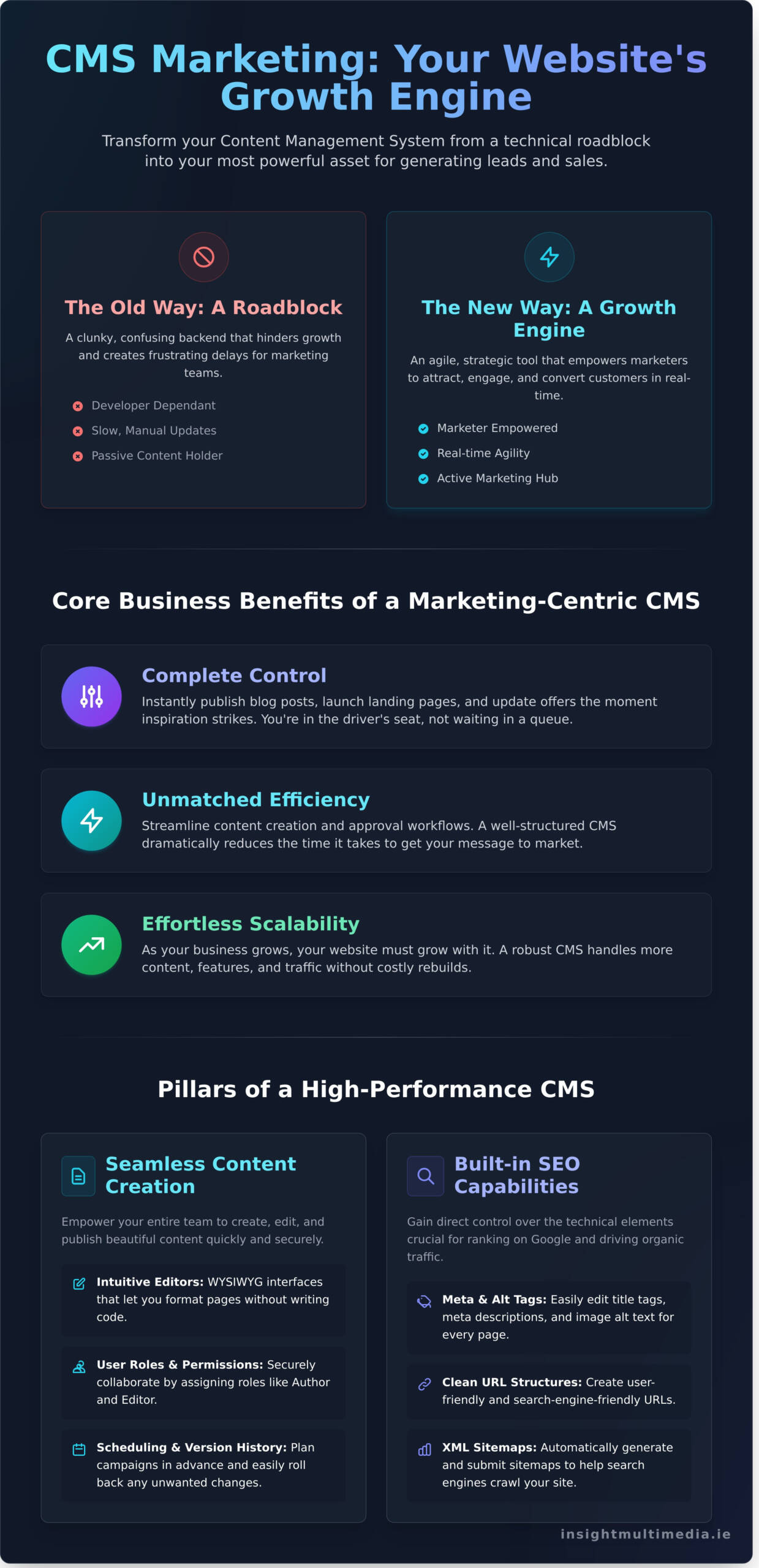
Historically, a CMS was the exclusive domain of developers. Marketers would have to submit a request to a technical team for even the smallest website update, creating frustrating delays. In today’s Irish market, that simply won’t cut it. Modern marketing demands speed and agility. A marketing-centric CMS removes these technical bottlenecks, empowering your team to launch campaigns, publish content, and react to market trends in real-time. This shift transforms the CMS from a passive repository into an active, strategic marketing tool.
Core Business Benefits of a Marketing-Centric CMS
When your CMS is aligned with your marketing goals, it delivers tangible business results that go far beyond simple content updates. It provides the foundation for a scalable and efficient digital presence for brands who refuse to blend in.
- Complete Control: Instantly publish eye-catching blog posts, launch stunning new landing pages, and update special offers the moment inspiration strikes. You are in the driver’s seat, not waiting in a queue.
- Unmatched Efficiency: Streamline your content creation and approval workflows across the entire marketing team. A well-structured CMS ensures consistency and dramatically reduces the time it takes to get your message to market.
- Effortless Scalability: As your business grows, your website must grow with it. A robust CMS allows you to expand your content strategy, add new features, and handle increasing traffic without being forced into a costly and disruptive rebuild.
The Pillars of CMS Marketing: Key Features for Success
A modern Content Management System is far more than a simple digital filing cabinet; it’s the engine that powers your entire digital presence. The right platform transforms your website from a static brochure into a dynamic, lead-generating machine. Choosing a CMS with a robust feature set is the foundation of any successful cms marketing strategy, delivering key business and marketing benefits that drive real growth. When evaluating your options, consider these four essential pillars to ensure your choice doesn’t just look good, but performs and converts.
Seamless Content Creation and Management
Your ability to act quickly on marketing ideas depends on how easily you can create and publish content. An elite CMS empowers your team, not hinders it. Look for:
- Intuitive Editors: A WYSIWYG (“What You See Is What You Get”) editor allows your team to format stunning blog posts and pages without needing to write a single line of code.
- User Roles & Permissions: Collaborate securely by assigning roles like Author, Editor, and Administrator. This ensures a marketing executive can approve content before a junior writer publishes it.
- Content Scheduling & Version History: Plan your campaigns with precision by scheduling content to go live at peak times. Made a mistake? Version history lets you roll back to a previous save in seconds.
Built-in Search Engine Optimisation (SEO) Capabilities
For brands that refuse to blend in, visibility on Google is non-negotiable. A marketing-focused CMS gives you direct control over the technical elements crucial for ranking. Essential SEO tools include the ability to easily edit title tags, meta descriptions, and image alt text for every page. It must also support clean, customisable URL structures and automatically generate an XML sitemap to help search engines crawl your site efficiently.
Powerful Integration and Extensibility
Your website is the hub of your digital ecosystem, and your CMS must connect seamlessly with the other tools you rely on. This is critical for creating a unified view of your customer and automating workflows. A great CMS allows you to plug in your CRM (like HubSpot or Salesforce) to capture leads, connect your email marketing platform (like Mailchimp) to build subscriber lists, and integrate Google Analytics to track performance without friction.
Tools for Personalisation and an Enhanced User Experience (UX)
Delivering a generic experience is no longer enough. The best cms marketing platforms provide tools to create personalised journeys that boost engagement and conversions. This includes the power to build targeted landing pages for specific ad campaigns, run A/B tests on headlines or calls-to-action to see what resonates with your audience, and even display dynamic content tailored to a visitor’s location or past behaviour.
How to Choose the Right CMS for Your Marketing Strategy
Selecting a Content Management System is one of the most critical decisions you’ll make for your digital presence. The “best” platform doesn’t exist; the right one is the system that aligns perfectly with your unique business goals and empowers your marketing team to execute flawlessly. Before diving into features, it’s vital to understand the foundational role of a CMS as a powerful engine for your entire digital strategy. Understanding what a Content Management System (CMS) is at its core will help you evaluate your options not just on technical specs, but on their potential to drive real business growth.
Popular CMS Platforms Compared for Marketers
From a marketer’s viewpoint, different platforms offer distinct advantages. Here’s a quick breakdown of the leaders:
- WordPress: The global standard for content-driven websites. Its unmatched flexibility and vast ecosystem of plugins (like Yoast for SEO) make it a powerhouse for blogging, lead generation, and building brand authority.
- HubSpot CMS: An all-in-one solution built for inbound marketing. It seamlessly integrates your website with a world-class CRM, email marketing, and sales tools, making it ideal for businesses focused on converting leads.
- Shopify: The undisputed champion for e-commerce. If your goal is to sell products online, Shopify provides a robust, secure, and marketing-focused platform with built-in tools for inventory, payments, and promotions.
- Headless CMS: The future-proof choice for ambitious brands. A headless CMS separates your content from the presentation layer, allowing you to deliver stunning experiences across a website, mobile app, and any other digital touchpoint from a single source.
Key Questions to Ask Before You Decide
To narrow down your choice, your team should address these fundamental questions:
- What are our primary marketing goals? Are we focused on generating inbound leads, driving direct online sales, or building brand awareness through high-quality content?
- Who will use the CMS daily? Your marketing team needs an intuitive interface they can manage without constant developer support.
- What is our budget? Consider both the initial build cost and ongoing expenses for hosting, maintenance, and premium plugins (often priced in Euro, €).
- What tools must it integrate with? A successful cms marketing strategy depends on a seamless connection with your CRM, analytics, and email marketing software.
The True Cost: ‘Free’ Templates vs. Custom-Built Value
While “free” or low-cost templates seem appealing, they often come with hidden costs. These can include expensive premium plugins, ongoing maintenance fees to fix compatibility issues, and critical security vulnerabilities. More importantly, a generic template forces your brand to fit into a pre-built box.
A custom-built solution, on the other hand, is a strategic investment. It’s designed from the ground up to achieve your specific marketing objectives, ensuring a high-performance, secure, and uniquely branded website. For brands that refuse to blend in, a bespoke site isn’t a luxury-it’s a necessity for standing out and converting visitors into loyal customers. Ready to build a website that performs as beautifully as it looks? Talk to our experts about a custom web solution for your business.
Putting it all Together: Your CMS as the Marketing Hub
A modern Content Management System is far more than a simple website editor; it’s the central command centre for your entire digital marketing strategy. It’s where your brand’s story is crafted, published, and measured. For brands that refuse to blend in, understanding this ecosystem is crucial for growth. The flow is cyclical: content is created in the CMS, distributed across multiple channels, and performance data flows back to inform your next move.
This dynamic process transforms your website from a static online brochure into a living, breathing marketing asset that actively generates business.
Fuelling Your Inbound and Content Marketing
Your CMS is the engine for attracting customers organically. By consistently publishing valuable, SEO-optimised blog posts, you answer your audience’s questions and draw in qualified traffic from search engines. From there, you can direct visitors to high-converting landing pages built within the CMS, using integrated forms to capture leads. Building out a resource centre with compelling case studies, white papers, and guides establishes your authority and nurtures prospects through their buying journey.
Powering Email, Social Media, and PPC Campaigns
The content you create in your CMS doesn’t just live on your website; it becomes the fuel for your wider marketing efforts. A new blog post can be shared in an email newsletter, repurposed into a series of social media updates, or used as the foundation for a targeted PPC ad campaign. Crucially, the landing pages you build in your CMS are the destination for that traffic, ensuring a seamless and consistent brand experience from the first click on an ad to the final conversion on your site.
Measuring Performance with Integrated Analytics
Effective cms marketing is data-driven. By integrating analytics tools directly with your CMS, you gain a powerful, 360-degree view of your performance. You can track key metrics like traffic sources, user behaviour, bounce rates, and, most importantly, conversions. This data reveals which content resonates most with your audience and which pages are successfully turning visitors into customers. This insight allows you to stop guessing and start making strategic, data-backed decisions to continuously optimise and improve your results.
Ultimately, a well-chosen and expertly configured CMS ensures your website doesn’t just look good-it performs, delivering tangible business conversions. If you’re ready to turn your website into a marketing powerhouse, get in touch with our team today.
Your CMS: The Heart of Your Digital Marketing Success
As we’ve explored, a Content Management System is far more than a simple website tool-it’s the command centre for your entire digital presence. The key is to choose the right platform and leverage its features for content, SEO, and user experience to drive growth. Ultimately, effective cms marketing is about transforming a technical platform into a dynamic engine for business conversions.
For brands that refuse to blend in, having the right partner is crucial. With over 20 years of award-winning experience, our full-service in-house team of designers, developers, and marketers has a proven track record of building websites that perform for Irish businesses. We create stunning digital experiences that don’t just look good-they are built to deliver tangible results.
Ready to build a website that performs? Get in touch with our Cork & Dublin teams today.
Frequently Asked Questions About Content Management Systems
What is the difference between a CMS and a website builder like Wix?
The primary difference is control and ownership. A website builder like Wix offers a user-friendly, all-in-one platform, but it’s a closed system with significant limitations. A true CMS, such as WordPress, is open-source software you own and host. This provides limitless customisation and scalability, allowing you to build a unique digital presence for a brand that refuses to blend in. For serious business growth, a CMS offers the professional flexibility you need.
Is WordPress the best CMS for marketing and SEO?
WordPress is an exceptional choice and powers over 40% of the web for good reason. Its vast ecosystem of plugins, like Yoast SEO, and customisable themes make it a powerhouse for digital marketing. While the “best” CMS depends on specific project needs, WordPress provides a robust, scalable, and search-engine-friendly foundation. It’s our platform of choice for clients who need a powerful engine for their cms marketing strategy, delivering both stunning design and tangible results.
How does a headless CMS differ from a traditional one like WordPress?
A traditional CMS like WordPress manages both the backend (content creation) and the frontend (the visible website) in one package. A headless CMS decouples them; it’s a pure content repository. The content is delivered via an API to any frontend you choose-a website, a mobile app, or even a smart device. This offers unparalleled flexibility and speed for complex, multi-channel projects but typically requires more specialised development expertise to implement effectively.
Can I change my CMS without completely rebuilding my website?
Unfortunately, migrating from one CMS to another almost always requires a complete website rebuild. Each CMS has its own unique architecture, theme structure, and database format. While content like text and images can be exported and imported, the design and functionality are not transferable. We view this as a perfect opportunity to enhance your site’s design, improve user experience, and ensure your new platform is built to drive business conversions from day one.
How much should I budget for a professional, marketing-focused CMS and website?
For a professional, custom-designed website built on a powerful CMS in Ireland, an SME should budget between €5,000 and €15,000+. This price can vary based on complexity, such as e-commerce integration or bespoke features. Think of this not as a cost, but as an investment. A professionally built site is engineered to attract customers, perform flawlessly, and convert visitors into real business, providing a significant return for your brand over its lifetime.
How does my choice of CMS affect my website’s speed and security?
Your choice of CMS is foundational to both speed and security. A well-coded, reputable CMS provides a strong starting point. However, performance is equally dependent on quality hosting, a lightweight theme, and optimised plugins. Security relies on the CMS core being kept up-to-date, along with all themes and plugins. Professional management is key to ensuring your digital asset is not only fast and reliable but also protected against emerging threats.
Related Posts