Why a Cheap Website Costs You More: The Hidden Business Costs
What if the lowest website quote becomes the most expensive choice for your business? That’s the question behind why a cheap website costs you more: a low upfront price can hide limited functionality, difficult repairs or the need for a rebuild sooner than you planned.
It’s sensible to watch your budget, especially when a website is one of several demands on an Irish business. But the launch price alone won’t tell you whether a site can support your goals. A polished design needs to work hard too, helping visitors find what they need, understand your offer and get in touch or buy.
This article will help you assess website value across its full lifespan, not just compare initial quotes. You’ll learn which costs can surface after launch, how maintenance, security and SEO fit into the picture, and how poor performance or a confusing customer experience can mean missed enquiries and sales. With a clearer view of the trade-offs, you can choose a website that suits your needs without paying for features you won’t use.
Key Takeaways
- Compare a website’s costs across its lifespan, including future changes and missed opportunities, rather than looking only at its launch price.
- Clarify what functionality, documentation and ownership are included so future updates are easier to manage.
- Look beyond appearance to usability, the mobile experience and the actions visitors can take.
- Compare proposals like for like by reviewing deliverables, ongoing care and how well each option fits your business goals.
- Choose a website that meets your defined needs without paying for features your business won’t use.
Why a Cheap Website Can Cost More Than Its Initial Price
A tight budget can make a basic website feel like the sensible place to start. If your immediate need is to explain what your business does and give customers a way to get in touch, a lean build may be entirely appropriate. The key is to know what the price covers and whether the finished site can do the job you need it to do.
Total website cost includes the cost of building, owning, improving or replacing a site, as well as the business value it may fail to help generate. This wider view explains why a cheap website costs you more in some cases, but it doesn’t mean every low-cost option is poor value. A focused site with a clearly defined purpose can be a sound investment when its scope fits your requirements.
What does a cheap website usually mean?
“Cheap” can describe a low price, but it can also mean reduced scope, limited functionality or work managed by the business itself. Those options aren’t automatically a problem. A simple site with essential pages and a clear enquiry route may be more useful than a complex build filled with features customers don’t need.
The risk is a mismatch between what your business needs and what the site delivers. A service business might need clear service information and a straightforward contact path. An online shop has different requirements, such as product pages and a purchase journey. The same quoted price can cover different deliverables, responsibilities and levels of ongoing care. Compare what’s actually included rather than relying on the label “website”.
Which costs belong in the full picture?
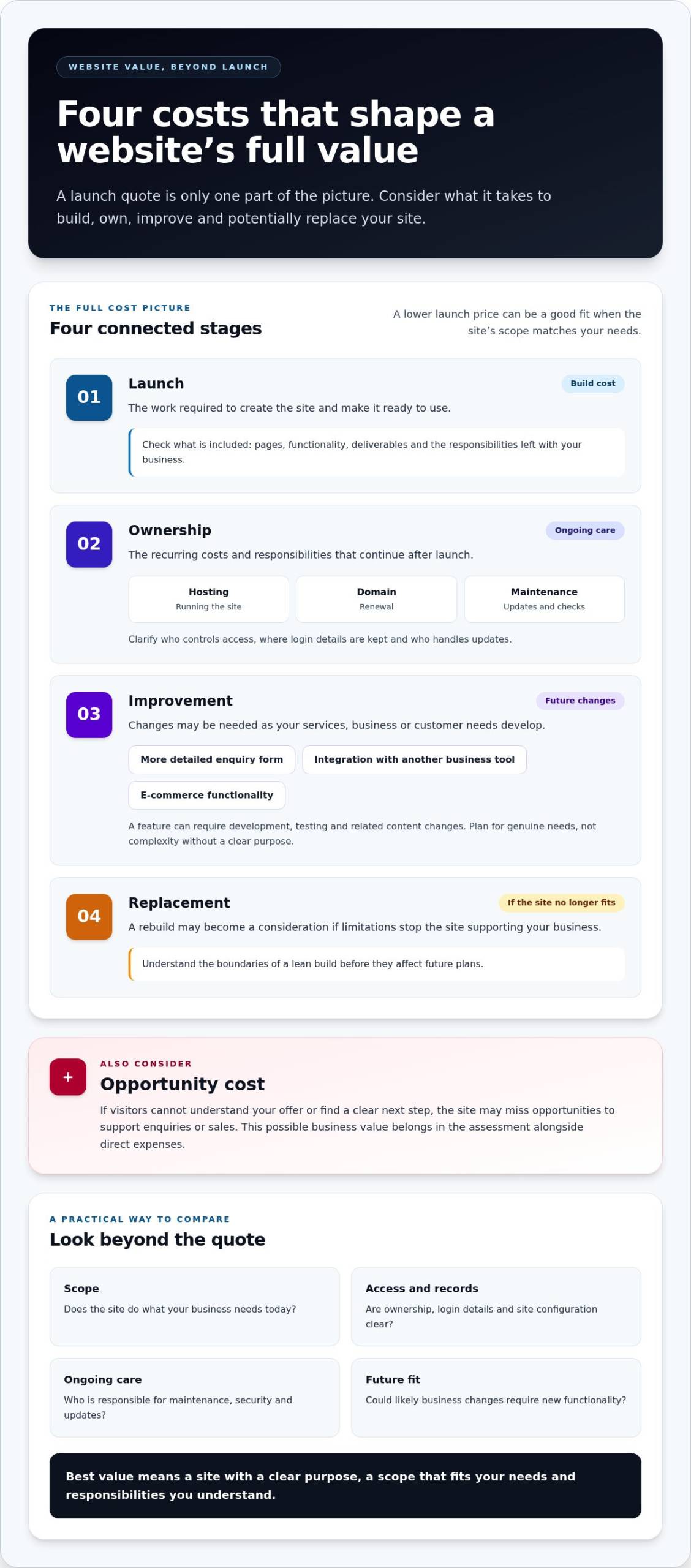
Think about four cost categories: launch, ownership, improvement and replacement. Launch covers the work required to create the site. Ownership can include hosting, domain renewal and maintenance. Improvements may be needed as your services or customer needs change. Replacement becomes a consideration if the site can no longer support the business.
Website development brings together design and functionality, while ongoing decisions influence how well a site serves its purpose over time. The website development overview provides context on these different aspects. For practical planning, identify who will handle updates and what support is included. Ongoing website maintenance can help keep care and upkeep visible in your ownership plan.
There’s also opportunity cost: the business value a website may fail to help generate. If visitors can’t understand your offer or find a clear next step, the site may miss opportunities to support enquiries or sales. That doesn’t mean every simple website will lose business. It means the site’s contribution belongs in the value assessment alongside its direct expenses.
- Launch: What is being created and made ready to use?
- Ownership: What recurring costs and responsibilities continue after launch?
- Improvement: What might need to change as your business develops?
- Replacement and opportunity: Could limitations lead to a rebuild or make it harder to achieve business goals?
Comparing these categories gives you a fairer basis for judging value. A lower upfront cost can be the right choice when the site is deliberately simple and fit for purpose. The important thing is to understand its boundaries before they affect your plans.
How Website Shortcuts Can Create Ongoing Costs
A website can meet today’s needs and still need to evolve as the business changes. The issue isn’t that every simple site will require extra development. Rather, a feature left out to keep the initial scope lean may become important later, and adding it can involve more than switching on a setting.
That’s one reason why a cheap website costs you more in some situations: a low upfront price may leave practical questions unanswered. Who controls the domain and hosting? Where are the login details kept? Is there a record of how the site is configured? If access or documentation is unclear, even routine changes can take longer to organise and complete.
When limited scope leads to extra development
Imagine a service business that launches with basic information but later wants a more detailed enquiry form. Or a growing company that needs an integration to connect its website with another business tool—a scenario where specialized engineering teams like Shark Matrix Technologies LLC can assist with custom CMS and backend integrations. An online shop may eventually need e-commerce functionality that wasn’t part of the original brief. These changes aren’t inevitable, but they’re easier to plan for when likely next steps are considered at the outset.
Adding a feature can involve agreeing what it needs to do, developing it, testing how it works with the existing site and adjusting related content. For example, an enquiry form should fit naturally on the relevant page, ask for the information the business needs and make the next step clear to visitors. Good planning helps distinguish a genuine business requirement from a feature that adds complexity without serving a clear purpose.
Why maintenance and security belong in the budget
Launch is a milestone, not the end of a website’s care. Websites rely on software, settings and connected components that may need attention to remain functional and up to date. If updates and checks are neglected, an issue can disrupt ordinary tasks, such as changing content or managing the site. Including maintenance and security in your plan makes responsibility for these tasks clear.
A predictable running cost is planned care. Avoidable rework is extra effort caused by unclear scope, access or decisions that could have been addressed earlier. The distinction matters. A planned maintenance arrangement is not proof that a website was built poorly. It is part of managing a digital asset over time. Insight Multimedia provides ongoing website maintenance and security to help care for a site after launch.
Before work begins, record who owns the domain and hosting accounts, who can access the site, what documentation will be handed over and who is responsible for updates. Then separate routine care from future development in your budget. This gives you a clearer view of what to expect, while leaving room to expand only when a genuine business need emerges. Insight Multimedia’s website design and development work can be shaped around your business requirements and the functionality your site needs.
How a Cheap Website Can Affect Trust, Visibility, and Enquiries
An affordable website can work well when its purpose and scope are clear. A small business that needs to explain its services and receive enquiries may not need complex features. The important question is whether the site makes it easy for the right visitor to understand the offer and take the next step.
That balance matters when considering why a cheap website costs you more. Saving on features that don’t support your goals can be sensible. But compromises that make essential information hard to find, weaken the mobile experience or limit useful content may work against the reason you built the site.
When design and usability affect customer confidence
A visitor who can’t quickly find what a business offers, where it operates or how to make an enquiry may leave without getting in touch. Confusing navigation and vague calls to action create friction, even if the site looks polished. On mobile, crowded pages or forms that are difficult to use can make the next step particularly awkward.
Visual consistency also matters. A considered use of brand colours, imagery and typography can help a business present itself clearly and professionally. Appearance alone doesn’t determine trust or conversions, though. Design works best alongside useful content, straightforward navigation and a journey that supports what the business wants visitors to do.
How technical limitations can constrain visibility
Search engines need to discover and understand a website’s content. Clear page structure, accessible text and sound development can help make that content easier to interpret. If important information is difficult to access or key pages are missing, the site may be less able to support visibility for relevant searches.
Good foundations don’t guarantee rankings. Search performance depends on multiple factors, including the usefulness of the content and the wider competitive context. A redesign alone can’t promise a particular position. For guidance on how search engine optimisation supports visibility, explore search engine optimisation services.
To judge whether a saving is appropriate, start with a specific business goal. If your website only needs to provide core information and a clear contact route, a streamlined build may be enough. If the goal is to sell online, collect detailed enquiries or support a broader range of services, check that the planned functionality and content can serve that purpose.
- Keep: Features and content that help visitors understand your offer or act on it.
- Question: Extras that add complexity without supporting a defined business need.
- Don’t compromise: On the content, usability or technical foundations your chosen goal relies on.
The right measure isn’t whether a website is cheap or elaborate. It’s whether the investment is proportionate to the job the site must do. A focused, well-considered website can be valuable. A lower price becomes a concern when it removes something essential to the visitor experience or business objective.
How to Compare Website Value Before Choosing a Budget
A useful comparison starts with the job your website needs to do, not the figure at the bottom of a proposal. Write down the outcomes you expect, then use the same requirements to assess each option. This makes it easier to see whether a lower price reflects a focused scope or leaves important work and responsibilities outside the project.
What should a fair website comparison include?
Compare like for like. List the agreed pages, features, content responsibilities and support around launch. Then note who manages hosting, updates and future changes, and what access or documentation you’ll receive. These details show what your team may need to take on after launch. The aim isn’t to choose the longest list of deliverables, but to understand what each proposal provides against the same needs.
Separate essentials from enhancements. A service business may need clear service pages and an enquiry route, while an online shop has different functional requirements. Mark each item as essential, useful later or unnecessary for now. If one proposal includes an optional feature and another doesn’t, account for that difference before deciding which offers better value. This prevents a headline price from disguising a different scope.
For further context on planning your design and development investment, explore website design and development. Use what you learn to clarify your requirements before comparing proposals.
How to estimate value without inventing a return
List the business outcomes the website is intended to support, such as more relevant enquiries, product sales or clearer information for existing customers. Then decide how you could recognise progress. Depending on the site’s purpose, suitable analytics might track visits to key pages, enquiry form submissions or completed purchases. Agree what will be measured and how it will be reviewed, rather than relying on a vague promise of growth.
Keep projections honest. An estimate of future enquiries or sales is an assumption, not a guaranteed result. It can help you assess whether a planned feature is worth considering, but its value depends on factors beyond the build itself. Treat early expectations as hypotheses to test against actual performance, then refine your priorities as you learn what visitors do.
This is a practical way to assess why a cheap website costs you more without assuming that a low-cost option is automatically wrong. Ask whether the scope supports your stated goals, whether ongoing responsibilities are clear and whether you can evaluate the results. A lean website can be the right investment if it covers the essentials. A cheaper proposal may be a poor fit if it omits something your business relies on.
Before deciding, put each option beside your requirements and mark what is included, what remains your responsibility and what can wait. That gives you a more grounded view of value than comparing prices alone. Plan your website around your business goals with Insight Multimedia.
Build a Website Around Your Business Goals, Not Just Its Launch Price
The right website investment is proportionate to your goals, requirements and available resources. A business that needs a polished online presence and a clear way to receive enquiries may be well served by a focused brochure site. A business selling products online or needing more complex functionality has different priorities. Neither needs to pay for features without a clear purpose.
This is the practical answer to why a cheap website costs you more: the price alone can’t tell you whether the solution fits. Define what your site must achieve, which functions are essential and what support it will need after launch. Then choose a build that serves those needs, with room to develop if your plans change.
What a considered custom website approach can address
Insight Multimedia creates bespoke brochure sites and more complex web solutions shaped around business objectives. Thoughtful design gives your brand a distinctive visual presence, while considered functionality helps visitors find information and take a relevant next step. The aim is to bring appearance and practical purpose together, rather than add complexity for its own sake. Explore custom website design and development as an approach built around your business requirements.
Plan for performance after launch
A website’s needs can change over time. E-commerce development can support businesses that need to sell online, while SEO can help strengthen search visibility through a considered strategy. Digital marketing may support wider promotional goals, and ongoing maintenance helps care for the site after it goes live. These services serve different purposes. None is an automatic outcome of launching a website, so match each one to a defined need.
Before deciding, consider how the pieces relate to your plans:
- Design and development: Create a site that reflects your brand and supports the actions visitors need to take.
- E-commerce: Include online selling functionality when it is central to your business model.
- SEO and digital marketing: Consider these when visibility and promotion are part of your growth plan.
- Maintenance: Account for ongoing care as part of managing the site beyond launch.
A website shouldn’t be judged by how much it costs to go live or by how many features it contains. Its value comes from how well it serves your business, your customers and your next stage of growth. Insight Multimedia brings design, development and related digital services together to help Irish businesses shape websites around those priorities.
If you’re planning a website or reviewing an existing one, discuss a website shaped around your business objectives with Insight Multimedia.
Make Your Next Website Decision with Confidence
Your website should be a deliberate investment in where your business is heading. Before setting a budget, decide what success should look like and what your customers need from the experience. That gives you a stronger basis for choosing what to build now, what can wait and how to judge whether the site is serving its purpose.
That’s the practical lesson behind why a cheap website costs you more: a low price is only a concern when it comes at the expense of what your business genuinely needs. Insight Multimedia is an award-winning creative web design company that creates custom websites for businesses with different requirements. The right approach can bring distinctive design and useful functionality together without adding features just for the sake of it.
If you’re ready to plan a website around clear objectives, discuss a website designed around your business goals. With a considered plan, you can make a confident investment and build an online presence ready to support your next stage of growth.
Frequently Asked Questions
Is a cheap website always a bad choice?
No. “Cheap” describes a price, not how effectively a site can serve a particular purpose. To judge why a cheap website costs you more, consider how long you expect to use it and whether you can keep its content if you later change direction. For a short campaign or an early business concept, a modest site may be a deliberate first step, provided you understand its limits before launch.
Can a DIY website builder work for a small business?
Yes, a DIY website builder can work if you’re comfortable taking an active role in creating and maintaining the site. Your team may need to prepare the copy and images, keep page layouts consistent and make routine edits. Consider whether that work fits your available time and skills. The platform’s editing tools may be straightforward, but producing clear, accurate content still takes effort. If setting up or maintaining the site internally proves too demanding, working with an agency like New Wave Digital Designs can provide professional implementation across popular platforms like WordPress, Shopify, and Squarespace.
What costs can come after a website launches?
Depending on how the site is set up, extra expenses may include paid add-ons, payment processing charges, analytics tools or the creation of new service and product content. An online shop, for example, may need new product descriptions and images as its range changes. List these possible costs separately from routine website bills, then include only the ones relevant to your setup when planning your budget.
Does a cheap website affect Google rankings?
A low build price doesn’t itself determine a Google ranking. A practical check is whether important pages can be reached through links on the site, have descriptive page titles and are available for indexing rather than accidentally excluded. Google Search Console can help monitor indexing and search queries. These checks can reveal issues to investigate, but they can’t predict or guarantee where pages will rank.
Can I improve an existing cheap website instead of replacing it?
Often, yes. Look at customer feedback and common questions your team receives to identify where the site causes confusion. Group potential fixes by their effect on customers, then make changes in a sensible order. Before altering the site, keep a backup and note how key tasks work, so you can check whether the changes have improved the experience or introduced new problems.
How can I compare website quotes fairly?
Alongside the proposed work, compare how each project handles decisions as it progresses. Check whether the proposal explains how requested changes are assessed, how feedback is gathered and what counts as approval of the finished work. These details help you anticipate how the project will run, not just what it will produce. Record any assumptions or exclusions so they don’t get lost during planning.