Irish Ecommerce Market Trends in 2026: What Retailers Need to Know
Irish shoppers make six times more in-store transactions than online transactions on an average day, according to Visa retail data reported by ThinkBusiness.ie in August 2026. That’s a reminder that the irish ecommerce market trends 2026 aren’t simply about moving every sale online. Digital convenience and physical retail continue to matter side by side.
For retailers, the challenge is deciding which signals should shape business decisions and which broad claims need more evidence. Online shopping habits vary by category and time of week, while a shopper’s confidence in a business and its website can influence where they buy. Start with evidence from Ireland, then check whether it reflects your own customers before changing your approach.
This article explores patterns in the reported consumer data, including when shoppers buy online, how to interpret the figures and why online and in-store experiences can support one another. It also offers practical ways to review your online store without overlooking the value of a physical shop. Use the guidance to identify a customer need, choose a focused improvement and assess whether it helps.
Key Takeaways
- Connected online and in-store experiences can give customers more choice, but retailers don’t need to operate both channels.
- Use the irish ecommerce market trends 2026 to distinguish reported shopper behaviour from assumptions that need more evidence.
- Compare shopping patterns across grocery, fashion and electronics, then check whether similar patterns appear in your own customer data.
- Choose a relevant trend, check your records, test one focused change and review the result before investing further.
- Build an online store around your customers’ needs, with distinctive design and practical functionality supporting the experience your business wants to deliver.
2026 Irish Ecommerce: Blending Online and In-Store Retail
Irish retailers need to understand both the convenience of digital shopping and the continuing role of physical shops. The useful question isn’t which channel will win, but how customers choose to browse, compare and buy. Some businesses may benefit from connecting online and in-person experiences; others can focus on the channel that best serves their customers. Omnichannel retail means connecting relevant online and offline touchpoints. It doesn’t require every retailer to operate both.
A customer might discover a product online, visit a shop to see it in person, then complete the purchase through whichever route suits them. Another might research in store and order later from home. The aim of omnichannel retail models is to make relevant touchpoints feel joined up, not to add channels for their own sake. For retailers developing an online presence, e-commerce solutions can support the experience they choose to offer.
What the reported Irish shopping patterns reveal
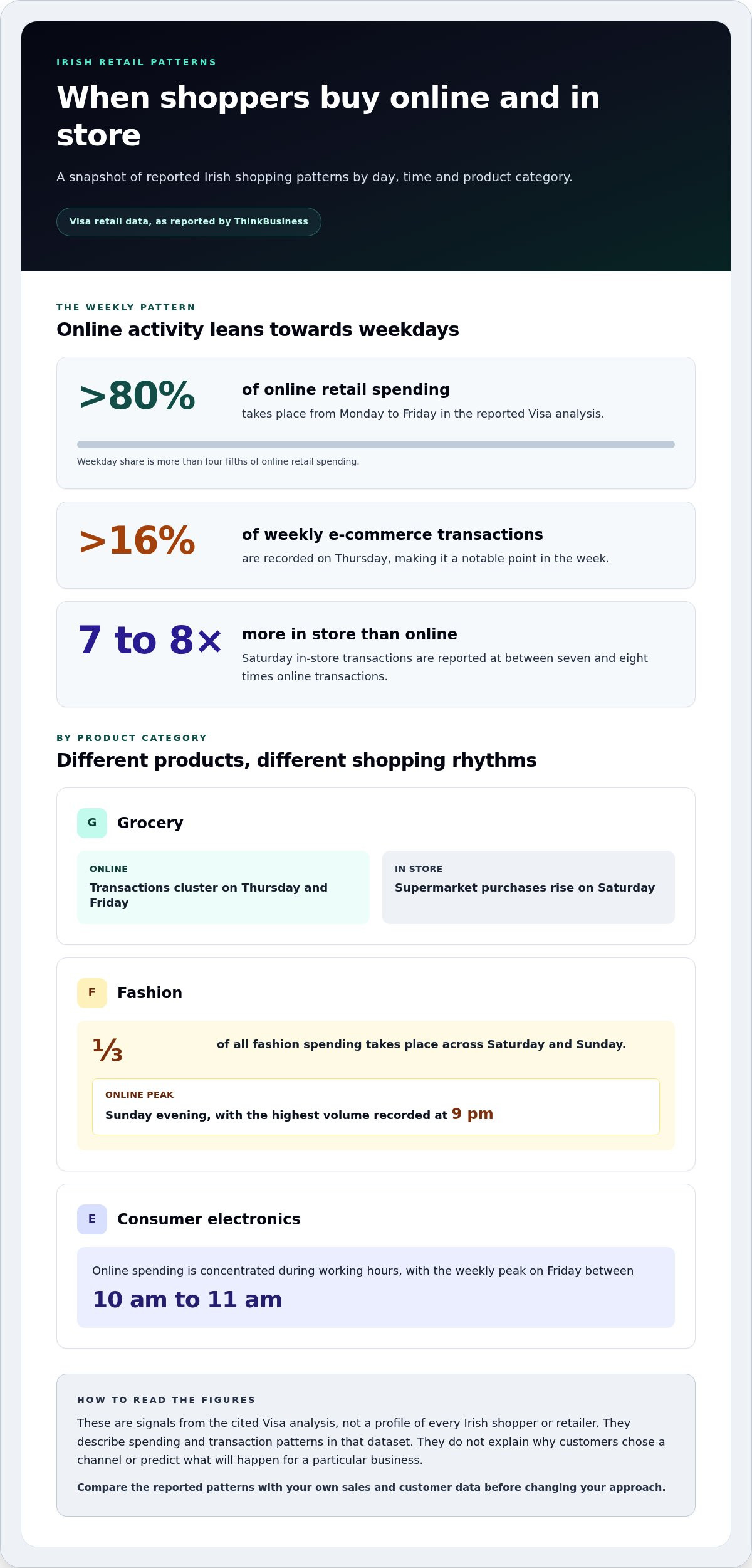
Visa card spending analysis reported by ThinkBusiness on 5 August 2026 describes a weekday pattern for online retail: more than 80% of online retail spending takes place from Monday to Friday, with Thursday accounting for more than 16% of weekly e-commerce transactions. The same reporting says in-store activity is comparatively stronger at weekends. On Saturdays, it records between seven and eight times more in-store transactions than online transactions.
These figures are a snapshot of the cited Visa analysis, not a profile of every Irish shopper or retailer. They describe spending and transaction patterns in that dataset. They don’t prove why customers chose a channel or predict what will happen for a particular business. ThinkBusiness identifies the Visa analysis and publication date, but the article doesn’t provide its full coverage or methodology. Treat the figures as signals to investigate, then compare them with your own sales and customer data.
The reported timing also varies by category. Online grocery transactions cluster on Thursdays and Fridays, while in-store supermarket purchases rise on Saturdays. Fashion spending is more weekend-focused, with one-third of all fashion spending taking place on Saturdays and Sundays. Online fashion shopping peaks on Sunday evenings, with the highest volume recorded at 9 pm. Online consumer electronics spending is concentrated during working hours and reaches its weekly peak on Friday between 10 am and 11 am. ThinkBusiness attributes these category observations to the Visa Retail Data Index.
Why online and physical retail aren’t opposites
A weekly average can hide important differences between products, shopping occasions and individual customers. A grocery retailer might use online ordering to serve customers planning ahead, while its shop remains important for weekend visits. A fashion business could make product discovery and purchase straightforward online, while continuing to serve customers who prefer to shop in person. These are possible ways to apply the reported patterns, not claims that every Irish retailer behaves this way.
The irish ecommerce market trends 2026 are most useful when they prompt better questions, not automatic investment in another channel. Look at when your customers browse and buy, which products they consider and where they complete purchases. If you operate both a physical shop and an online store, assess whether the experiences complement each other. That evidence can help shape a distinctive, functional online store without treating digital growth as a replacement for the shop.
The Irish ecommerce trends behind changing digital consumer expectations
Retailers need to separate what research measures from what it might mean for their own customers. Broad digital access makes online tasks part of everyday life, but it doesn’t show by itself that ecommerce sales are growing or reveal what shoppers expect from a particular store. For businesses assessing the irish ecommerce market trends 2026, this distinction matters: market evidence can guide questions, while customer data should shape decisions.
How digital habits can shape online shopping expectations
A US Department of Commerce country guide on ecommerce in Ireland, published on 2 February 2026, reports household internet access of 94% and smartphone penetration of 90%. These figures describe access to digital devices and connectivity. They don’t establish how often people shop online, which retailers they choose or whether mobile browsing leads to a purchase.
It’s reasonable to consider how familiarity with digital tasks may shape expectations. Customers accustomed to finding information online may value clear product details, straightforward navigation and a checkout that’s easy to understand. These are useful design questions, not proven conclusions about every Irish shopper. Test them against your own evidence: review the questions customers ask, the pages they visit and where they leave a purchase unfinished, if that information is available.
Use findings from Deloitte’s Ireland report only when they can be verified in its published content. A broad discussion of digital life isn’t, by itself, evidence of a specific ecommerce behaviour. Don’t attach sales predictions or claims about payment preferences to a report unless its findings directly support them.
What retailers can and cannot infer from trend reports
A trend report records activity within a particular source, period and method. It may reveal what happened in the data examined, but it doesn’t necessarily explain why customers acted that way. A change in online activity, for example, could have several possible causes. Unless the research investigates those reasons, attributing the change to convenience, technology or a new preference goes beyond the evidence.
The same care applies to card spending analysis. Card data can describe the transactions captured by that analysis, but it shouldn’t automatically be treated as a complete count of consumers or payment methods. Check the source’s publication date, coverage, methodology and definitions before using a figure to set business priorities. For a broader view of Irish retail activity, the Central Statistics Office Retail Sales Index provides an official reference point. Read its measures in context, and don’t assume they explain individual customer motivations.
National data is a starting point, not a substitute for customer evidence from your own business. Compare published patterns with your store’s sales, site searches, customer feedback and enquiries where those records are available. Look for repeated signals before changing the customer journey, then review whether the change helps your audience. A distinctive, functional ecommerce website can put customer-led decisions into practice without relying on unsupported predictions.
How Irish ecommerce behaviour differs by shopping day and product category
Timing data is most useful when it helps a retailer ask a sharper question about its own customers. The Visa Retail Data Index findings reported by ThinkBusiness compare activity across grocery, fashion and consumer electronics. Rather than treating those categories as a ready-made schedule, use the comparison to examine whether your own customer activity varies by product type and shopping occasion.
What the reported data says about shopping days
A day-by-day view can reveal differences hidden by an overall sales total. Compare product page visits, orders and customer enquiries across equivalent periods, then check whether any pattern appears consistently in your own records. Keep the measures distinct: visits, transactions and sales value describe different things, so one shouldn’t stand in for another.
The ThinkBusiness reporting of Visa analysis is a prompt for this kind of segmentation, not a timetable for every shop. The reporting doesn’t establish that its measures and comparison periods match across all categories. Before drawing a conclusion, identify what your own records capture and whether you’re comparing like with like. For example, compare the same measures across the same kinds of days rather than combining browsing activity with completed orders.
Why retail category matters when interpreting the trends
Use category differences as a reason to look more closely at your own business. The questions below turn the reported comparison into a practical review, without assuming your customers will follow a national pattern.
| Category | Useful question for your own data |
|---|---|
| Grocery | Do customer orders and shop activity vary by product group or shopping occasion? |
| Fashion | Do browsing and completed orders show the same pattern, or do customers return to buy later? |
| Consumer electronics | Do customers research products at one time and complete purchases at another? |
These are analysis prompts, not findings from the Visa dataset. They can help distinguish a genuine pattern in your own business from an assumption based on a category label. A store selling across several categories may also find that an overall average hides different customer journeys. Review categories separately where your records allow, and avoid extending conclusions to product types the analysis doesn’t cover.
For broader Irish market context, the International Trade Administration’s Ireland eCommerce guide can sit alongside category-level research. Use it as context, then assess whether its information is relevant to your customers and commercial objectives.
Before adjusting a campaign, compare your own data over consistent periods and decide what you want to learn. If a pattern appears, test a focused change to messaging or timing and review the result against your original question. A reported peak doesn’t guarantee an opportunity for your store. This measured approach helps apply the irish ecommerce market trends 2026 to your own business without mistaking a market signal for a sure outcome.
How Irish businesses can respond to ecommerce trends without chasing every prediction
Market reports are most useful when they help you ask a better question about your customers. A national pattern may be worth investigating, but it doesn’t automatically describe your audience or justify a change to your website, marketing or operations. Use a clear process to move from a possible signal to a decision grounded in evidence.
Choose which market signals deserve attention
Start by matching a reported trend to your product category, audience and business objective. A pattern in grocery shopping may have little relevance to a retailer selling fashion. A broad claim about mobile behaviour also needs to be checked against how your customers use your site. Treat unverified forecasts as questions to investigate, not as facts to build a plan around.
Prioritise signals you can compare with first-party information, such as sales records, customer enquiries, site searches and feedback. Ask whether the trend points to a problem or opportunity you can observe. If it doesn’t connect to a clear business goal, it may not deserve attention now. A simple working note can help: record the reported claim, the customer need it might relate to, the evidence you have and what you still need to learn.
Turn a relevant signal into a measured test
Once you’ve identified a useful question, make a focused change and decide in advance what you want to learn. Where practical, change one customer-facing element at a time. This makes it easier to interpret what happened, although normal variations in demand can still affect the result.
- Choose a relevant trend. Explain why it might matter to your category, customers and business objective.
- Check your own evidence. Review the relevant sales, site activity or customer feedback, using a consistent period for comparison.
- Test one focused change. For example, clarify product information if customers regularly ask the same question, then observe whether related enquiries or purchase behaviour changes.
- Review what happened. Compare the result with your starting point and consider other factors that may have influenced it before deciding what to do next.
Choose measures that reflect your question rather than chasing a single headline figure. Depending on the test, you might review product page visits, completed orders, enquiry themes or checkout progress. These are possible measures, not prescribed benchmarks. Set a relevant comparison for your business, and don’t assume that a short-term change proves a lasting effect.
When assessing whether a website or proposed improvement supports wider business goals, consider both the intended outcome and the resources required. Be clear about what the investment is meant to achieve and how you’ll evaluate it. This keeps the assessment tied to your objectives without assuming a particular commercial result.
The irish ecommerce market trends 2026 can inform your thinking, but your customers’ evidence should shape the response. If you’ve identified a genuine customer need and want to build a more considered online experience, explore custom ecommerce website development.
What Irish ecommerce trends mean for a future-ready online store
The most useful response to ecommerce trends isn’t to redesign a store around every new prediction. Start with what your customers need to do, then use reliable evidence to decide whether your current online experience supports them. For Irish retailers, that could mean making product information easier to understand, helping customers find the right items or making the path from browsing to purchase more coherent. The right priorities depend on the business, not the headline trend.
Connect store design to the customer journey
A well-designed online store brings visual identity and practical function together. Its structure should reflect the products, information and customer journey that matter to the business. Clear navigation, considered page layouts and consistent brand presentation can help make the experience distinctive while keeping it useful. These are design considerations, not promises of a particular sales outcome.
Before planning changes, map the steps a customer takes, from arriving at the store to deciding what to buy. Note where people need more information, where choices may be unclear and what the business needs to manage behind the scenes. This keeps design decisions grounded in real requirements rather than adding features simply because they’re fashionable. For planning context, retailers can also consult an ecommerce web design guide for Ireland.
If existing tools or layouts make it difficult to deliver the experience your business has chosen, tailored custom ecommerce solutions may be worth considering. Insight Multimedia develops custom ecommerce websites and online stores, combining creative design with experienced development. A custom platform is one possible route, not a requirement for every retailer. Let your needs and the evidence you’ve gathered guide the decision.
A measured next step for Irish retailers
Choose one verified trend that appears relevant to your customers. Check whether your own enquiries, sales patterns or website activity support it, then identify a specific part of the customer experience you want to improve. If the evidence is limited or points in different directions, gather more insight before committing to a larger change. That restraint can be as valuable as acting quickly.
Review any proposed update against the original need. Ask whether the store makes the intended task clearer or easier, and whether the change fits the way your business operates. Keep the assessment proportionate: the purpose is to learn whether the experience is better aligned with customer needs, not to assume a guaranteed commercial result.
The irish ecommerce market trends 2026 offer useful context, but lasting decisions begin with customers and evidence. A functional, distinctive online store can support the experience your business chooses to create, while leaving room to evolve as genuine needs emerge. If you’re considering how a tailored store could fit your plans, explore Insight Multimedia’s approach to ecommerce.
Build your next step around your customers
The irish ecommerce market trends 2026 can help frame your thinking, but your next move should come from what your customers need and what your business can confidently support. Choose one opportunity to explore, decide what a better experience would look like and use evidence to guide the work. A clear focus can help you build a distinctive online presence without chasing every new prediction.
Insight Multimedia is an award-winning creative web design company that builds custom ecommerce websites and online stores. For more than 28 years, the team has combined creative design with experienced development to create practical digital solutions for businesses across Ireland.
If a tailored online store is the right next step for your business, Explore custom ecommerce solutions for your business. Take the next step with a clear purpose, a strong customer focus and room for your business to grow.
Frequently Asked Questions
Is ecommerce still growing in Ireland in 2026?
Ecommerce activity is visible in Ireland in 2026, but the Visa evidence reported by ThinkBusiness doesn’t establish a complete market growth rate. It describes when captured online and in-store activity occurred, not whether total ecommerce sales rose over time. To assess growth, check the latest relevant Central Statistics Office data, review its period and definition of online sales, and compare like with like. Changes in shopping behaviour and market growth are separate questions.
How reliable are Visa card spending figures for understanding Irish online shopping?
Visa card spending figures can reveal patterns within the transactions and period covered by the analysis. ThinkBusiness reported Visa findings on 5 August 2026, but they shouldn’t be treated as a complete count of all Irish shoppers, purchases or payment methods. Check the original methodology, coverage and definitions, then compare the reported pattern with your own relevant sales records before using it to inform a business decision.
Does online retail spending data include every type of online purchase?
Not necessarily. What a report includes depends on its definitions, data source and coverage. A card spending analysis shouldn’t be assumed to capture transactions made through every payment method, or activity from every retailer and shopper. Before citing a figure as representative of the whole Irish online market, read the methodology and note any exclusions. For a business decision, establish whether the measure reflects the customers and transactions you want to understand.
Can national ecommerce trends predict what customers of one Irish business will do?
No. National findings offer context, not a forecast for an individual business. The irish ecommerce market trends 2026 may point to behaviour worth investigating, but their relevance depends on your product category, audience and business model. Compare the pattern with your own sales, customer questions and website activity before changing a campaign or store journey. If your data tells a different story, investigate that difference rather than forcing your plan to match a national average.
What is the difference between an ecommerce trend and a short-term shopping peak?
A peak describes activity during a defined period or within a particular dataset; a trend suggests a pattern that persists or recurs over time. One busy shopping day doesn’t prove that customer behaviour has shifted for the long term. Before describing a peak as a trend, compare similar periods and check whether other reliable sources show a consistent pattern. Keep the date range and measure clear so readers understand what the observation represents.
How often should Irish retailers review ecommerce market trends?
There’s no single review schedule that suits every Irish retailer. Revisit relevant market evidence as part of your normal business performance reviews and when meaningful new data becomes available. Keep measures and time periods consistent so comparisons remain useful, and favour sources with clear definitions and methodology. This helps distinguish a meaningful signal from a passing headline without making changes simply because a new prediction has appeared.