How to Build a Website That Generates Sales
What if your website isn’t generating enough enquiries or purchases because of what happens after someone arrives, rather than a lack of traffic? A website that generates sales needs more than striking visuals. It should make the next step clear, easy and relevant, whether someone is discovering your business or ready to buy.
If your website attracts attention but struggles to turn visitors into customers, it can be hard to know what to change. Design, functionality and marketing all shape the customer journey. When they work in isolation, visitors may be left unsure where to go next or why your offer suits them.
This guide shows you how to assess your website as a practical sales tool, from first impression to enquiry or purchase. You’ll learn how to clarify the customer journey, consider mobile visitors, connect marketing activity to website results and prioritise improvements. With thoughtful design and useful functionality working together, your website can better support your business goals.
Key Takeaways
- A website that generates sales combines distinctive design with a clear commercial purpose, guiding relevant visitors towards an enquiry or purchase.
- Map the customer journey from discovery to follow-up, making each step answer the visitor’s next question.
- Compare website approaches by the action you want customers to take and the functionality needed to support it.
- Audit your website by defining its conversion goal, reviewing the visitor journey and prioritising improvements using available evidence.
- Connect custom design and development with relevant e-commerce, SEO or Google PPC support to align your website with business objectives.
What makes a website generate sales rather than simply look good?
A polished website can make a strong first impression, but appearance alone won’t guide someone towards an enquiry or purchase. A website that generates sales is built around a clear business goal: helping relevant visitors understand what you offer, decide whether it suits their needs and take a useful next step.
A sales-focused website guides the right visitors towards a meaningful business action through clear information, purposeful design and a considered customer journey.
A commercial purpose doesn’t mean sacrificing creativity. Strong design can make a brand distinctive, help people understand information and draw attention to useful actions. Custom design and practical functionality should support one another, so visual choices help visitors rather than distract them. The right approach depends on your audience, offer, traffic and the route each page provides to the next step. Even an attractive website can underperform if it attracts the wrong visitors or leaves them uncertain about what to do.
This is the thinking behind Conversion Rate Optimisation: using evidence to improve how effectively a website encourages visitors to complete a desired action. It’s a useful perspective whether your goal is to generate qualified enquiries or sell products online.
What should a sales focused website help visitors do?
Start by identifying what someone needs to do or understand when they arrive on each important page. A service page should explain what you do, who the service is for and how to enquire. A product page should give shoppers enough useful information to assess an item and decide whether to buy. Make the main action easy to recognise and relevant to the page.
- For enquiry led goals: explain the service and its benefits, then provide a straightforward route to enquire.
- For online sales: provide clear product information and an easy route from browsing to purchase.
Visitors need enough clarity to judge whether your offer is relevant and worth considering. Explain what you do in familiar language, answer likely questions and make important details easy to find. If a page tries to speak to every audience at once, its main message can become difficult to grasp. Give each page a clear purpose, then include the information that helps visitors act on it.
Which signals suggest a website is not supporting sales?
Look for friction in the customer journey. Calls to action may be vague, key information may be hard to find, or a page may not make the next step apparent. A steady flow of visits doesn’t prove that a website is commercially effective. Traffic tells you that people arrive, but not whether they are the right audience, find what they need or complete an intended action.
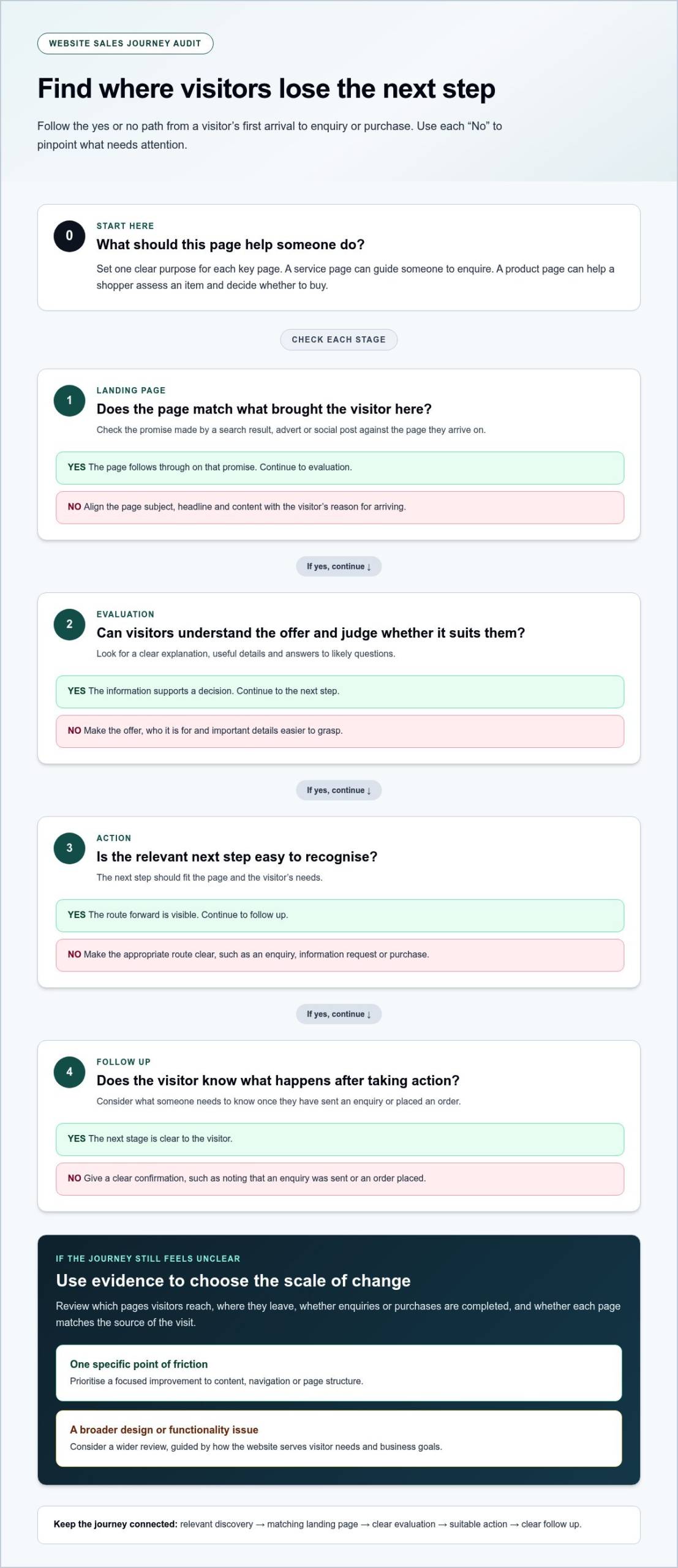
Before deciding that a redesign is the answer, review the evidence available. Check which pages visitors reach, where they leave, whether enquiries or purchases are completed and whether each page matches the source of the visit. These checks can help distinguish a design issue from a mismatch in audience, offer or journey.
- Define the intended action for each key page.
- Ask someone unfamiliar with the site to find the relevant information and next step.
- Use what you observe to prioritise changes instead of changing the entire site based on an assumption.
A focused improvement to content, navigation or page structure may be enough to address a specific problem. If the evidence points to a broader issue with the design or functionality, a wider review may make more sense. In either case, make decisions based on how the website serves visitor needs and commercial goals.
How does a website guide a potential customer from discovery to sale?
A customer journey is made up of small decisions, not one leap from first visit to purchase. Someone might find a business through a search result, advert or social post, then look for evidence that the offer suits their needs. Each page should answer the question the visitor is most likely to have at that stage, without overwhelming them with every detail at once.
Think of the journey as a connected sequence:
- Relevant discovery: A search result or marketing message attracts people whose needs match the offer. Its wording should set an accurate expectation about what they’ll find.
- Landing page: The visitor arrives on a page that follows through on that promise. The headline, content and imagery should make the subject clear straight away.
- Evaluation: The visitor considers whether the product or service is suitable. Clear explanations, relevant evidence and answers to likely questions help them assess the fit.
- Action: The page makes an appropriate next step visible, whether that means making an enquiry, requesting information or completing a purchase.
- Follow up: The visitor receives a clear indication of what happens next, such as confirmation that an enquiry has been sent or an order placed.
Consistency matters at every stage. If an advert promotes a particular service or offer, its landing page should address that same subject. Sending visitors to a general page and making them search again adds unnecessary work. Connected digital marketing for Irish businesses and website content can help ensure that the promise attracting a visitor is reflected in the experience that follows.
How should landing pages connect visitor intent with the offer?
Build the page around the reason someone arrived. State what the offer is, who it is for and the value it provides. Support those points with relevant details, such as how a service works or what a product includes. Keep the information focused on helping visitors make a decision. A page that mixes unrelated audiences or offers can blur the message and make it harder for someone to judge whether it’s relevant.
What makes the next step clear and persuasive?
Give each page one primary call to action that suits the visitor’s decision stage. Someone still considering a service may need a clear enquiry option, while a shopper who has chosen a product needs a direct route to purchase. Supporting links can be useful, but they shouldn’t compete with the main action. Explain what happens after someone acts, so they know whether they’re submitting an enquiry or completing an order.
A clear next step turns interest into action by showing visitors what to do and what to expect afterwards. A website that generates sales makes this transition feel natural, not forced. If your marketing and website need a more connected direction, explore how Insight Multimedia approaches digital experiences around business goals.
Which website elements should a business compare before investing?
Begin with the action your website needs to support. A service business looking for qualified enquiries has different priorities from a retailer selling products online. The right approach depends on your offer, customers and how they need to interact with the site. No platform, feature or visual style guarantees sales. Compare each option by how well it supports the customer journey and your day-to-day needs.
Use this framework to compare the main options:
- Business goal: Generate relevant enquiries, or help customers discover and buy products.
- Website approach: A bespoke brochure website can prioritise services and enquiries. An e-commerce platform is structured around product browsing and online purchases.
- Suitable functionality: Enquiry-focused sites need clear service information and contact routes. Online shops need product discovery, useful product details, a basket and checkout.
- Trade-offs: A tailored site can reflect a distinctive brand and specific business needs, while requiring decisions about its structure and functionality. An e-commerce platform provides a sales-focused framework, but its features and setup should suit the product range and the way the business operates.
Look beyond the headline feature list. Design should express the brand while making important content easy to notice. Usability includes clear navigation and a straightforward route to the intended action. Content should answer customer questions and explain the offer. Technical foundations should support the functions the site needs. Marketing integration should help the right visitors arrive on relevant pages. These factors work together. A visually striking layout won’t compensate for unclear information, and a useful feature won’t help if customers can’t find it.
When is a bespoke business website the better fit?
A bespoke structure can suit a service business with a distinctive offer, a specific audience and qualified enquiries as its main goal. Pages can be organised around how potential clients understand the service, with branding and functionality shaped to the business rather than forced into a generic layout. For broader planning, consider the key decisions in your website design strategy, from each page’s purpose to the features that support it.
When does an e-commerce website need a different approach?
An online shop needs to connect product discovery with product information, the basket and checkout. Each step should help customers make a considered purchase without unnecessary friction. Compare platform and functionality choices against the size and organisation of your product range, operational requirements and customer needs. If you’re planning to sell products online, e-commerce solutions can be built around that buying journey.
Before investing, write down the customer action you want, the pages needed to support it and the functionality those pages depend on. This gives you a practical basis for comparing approaches. For small businesses evaluating structured starter, business, or online store packages, options from providers like Good Budget Website illustrate how functionality can be tailored to practical commercial needs. It keeps creative direction and commercial purpose in view without treating any single design or platform as a shortcut to sales.
How can you assess and improve a website’s ability to generate sales?
A useful audit starts with a specific business outcome, not a vague aim to “get more from the website”. Decide whether a page should generate qualified enquiries, product purchases or another meaningful action. Then review how effectively the page supports that purpose. Assess an enquiry form by the relevance of the enquiries it brings in, and assess product pages by whether visitors can complete a purchase.
Work through the review in sequence:
- Define the conversion goal. Choose the action that matters for each key page, such as submitting an enquiry or completing an order.
- Inspect the journey. Follow the route from the entry page to the action. Look for unclear wording, missing information, confusing navigation or unnecessary steps.
- Review the evidence. Use available website analytics alongside business records, such as enquiry details or completed orders. Consider what visitors do and whether the outcomes match the page’s purpose.
- Prioritise changes. Address the most relevant barrier supported by evidence, then review what happens after the change.
Traffic sources matter too. Search Engine Optimisation can help relevant organic visitors find the site, while Google PPC advertising can bring people to targeted pages. Neither replaces a clear, useful website experience. Check that the search terms or advert message align with the landing page, then assess whether visitors continue towards the intended action. A search engine optimisation guide can help you consider how organic visibility connects with the pages visitors reach.
What should you review in a website conversion audit?
Review each important page as a visitor would. Is the offer clear? Can the intended audience recognise that it is relevant to them? Is the next action easy to find? Then complete the enquiry or purchase journey yourself, noting friction such as repeated information requests or a checkout step that causes uncertainty. Use analytics and business records where available, but compare results with your own objectives rather than relying on an unsupported benchmark.
Consider actions in context. An enquiry form may receive submissions, but those enquiries should also be relevant to the service. A product page may attract visits, but completed purchases are a more direct signal for an online sales goal. The page’s purpose gives the evidence its meaning.
How should a business prioritise website improvements?
Rank potential changes by how much they matter to customers, how closely they support a business objective and how strong the evidence is. A confusing button label or unclear service description may call for a focused content improvement. A broken journey or functionality gap may need more substantial development. Separate these types of work so a larger project doesn’t hold up practical fixes.
Review marketing and on-site results together. If an SEO page attracts relevant visitors but few enquiries, examine its message and route to action. If a PPC campaign sends visitors to a mismatched page, align the advert and landing page before drawing conclusions about the website.
Insight Multimedia brings design, development and digital marketing together to support commercial objectives. Discuss your website goals with Insight Multimedia and consider how a focused review could guide your next improvements.
How can Insight Multimedia create a website built around sales goals?
A successful web project starts with the business, not a template. Insight Multimedia connects custom design and development to each client’s commercial objectives, shaping a digital experience around the offer, the people it needs to reach and the actions the website should support. The aim is to bring distinctive creative direction and practical functionality together, giving the finished site a clear role in the wider business.
Insight Multimedia is an award-winning creative web design company, combining visual thinking with web development and digital marketing expertise. A website that generates sales needs each of these decisions to support the customer journey, while recognising that results depend on the business, its offer and the visitors it attracts.
What does a joined up web project need to consider?
Start by clarifying what the business offers, who its target customers are and what it wants visitors to do. A service company may prioritise relevant enquiries, while a retailer may need customers to find products and complete purchases online. Some businesses need to support both actions. These priorities help define the website’s structure and the functionality required.
Visual identity and user experience should work together. Brand design gives the website a recognisable character, while page layouts, navigation and content help visitors understand the offer and move through the site. Development turns that plan into a functioning website, with features suited to the project. These choices should reflect the business’s needs rather than add complexity without purpose.
Digital marketing supports a different part of the process. Search Engine Optimisation can help relevant organic visitors discover the site, while Google PPC advertising can direct targeted traffic to relevant pages. Neither replaces thoughtful website design and development. Marketing attracts visitors; the website needs to give them a coherent experience and a suitable next step.
What should the next step look like for your business?
Before planning a project, decide whether your priority is to generate enquiries, sell products online or support both. Consider which pages, information and functions those actions require, and what matters most to your customers as they explore the offer. A focused brief gives the project a sound basis and helps shape recommendations around your commercial goals and the scope of work involved.
For an online shop, e-commerce development can bring product discovery and the purchase journey into the website’s core structure. For a business focused on enquiries, custom design and development can organise content around its services and the questions prospective customers need answered. SEO or Google PPC can be included when visibility and traffic acquisition are part of the plan.
Insight Multimedia brings creative design, development and relevant marketing disciplines together to support business objectives, with each service serving a distinct role. If you’re ready to explore a website project, discuss your web design and development requirements with Insight Multimedia. Start with the goal your website needs to serve, and shape the project around it.
Make your next website decision count
Your next step doesn’t need to begin with a complete rebuild. Identify the customer action your website most needs to support, then consider what would make that step clearer and more useful. A focused change to a page, message or journey can give you a practical place to begin. A broader project can follow when your business goals call for it.
A website that generates sales is an ongoing business asset. As your offer and customer needs evolve, your website can evolve with them. Keep its purpose clear, make decisions with your customers in mind and give each improvement a defined reason for being there.
Insight Multimedia can help shape a website project around your business objectives, bringing creative thinking and practical planning together. Discuss a website built around your business goals and take the next step towards a digital experience designed to move your business forward.
Frequently Asked Questions
What makes a website generate sales?
A website generates sales when it helps the right people understand an offer and take an appropriate action. For a consultancy, that might mean helping a prospective client understand the service before submitting a relevant enquiry. For a retailer, it could mean making it easy to compare products and place an order. A website that generates sales connects its content, design and functionality to customer needs without promising a particular outcome.
Can a website generate sales without paid advertising?
Yes. People may find a website through organic search, recommendations, social media or direct visits. Helpful pages that address real customer questions can support discovery and build confidence. The right mix depends on the audience and the business. Without paid campaigns, it’s still useful to understand where visitors come from and whether those channels bring people likely to enquire or buy.
How do I know if my website is generating sales?
Compare website activity with real business outcomes. For an enquiry-focused site, look at how many enquiries lead to relevant conversations or new clients. For an online shop, compare visits with completed orders and review where customers leave the buying process. Use analytics alongside sales or enquiry records, and note how people found you. This provides a clearer picture than counting visits alone, though it may not explain every customer’s decision.
Does a sales generating website need e-commerce?
No. E-commerce is only needed if customers are meant to choose and buy products directly through the website. A business selling professional services may be better served by clear service pages and a straightforward way to make an enquiry. The important decision is how customers should take the next step. Adding a shop where it doesn’t suit the business can create extra complexity without supporting its main commercial purpose.
How often should a business improve its website?
There’s no single schedule that suits every business. Review the site when you introduce a new service, change an offer, notice repeated customer questions or see a change in enquiry or sales patterns. It’s also useful to revisit key pages periodically, even when the business hasn’t changed. Considered updates can keep information accurate and relevant, while a larger review may be appropriate when the website no longer reflects how the business operates.
Will redesigning my website automatically increase sales?
No. A redesign can improve how clearly the site presents an offer or how easily customers use it, but those changes don’t guarantee more sales. Results also depend on whether the right people visit and whether the offer meets their needs. Before committing to a new design, identify the specific problem to solve. That gives the project a clear purpose and a more meaningful way to assess its impact.
Should I focus on SEO or Google PPC to bring customers to my website?
Choose based on your goals, audience and marketing plans. Search Engine Optimisation supports visibility in organic search, while Google PPC advertising uses paid campaigns to bring visitors to selected pages. Consider the searches you want to reach and whether your landing pages match that intent. You can use either approach or both, then assess each by the relevance of its visitors and the enquiries or purchases associated with them.